
.
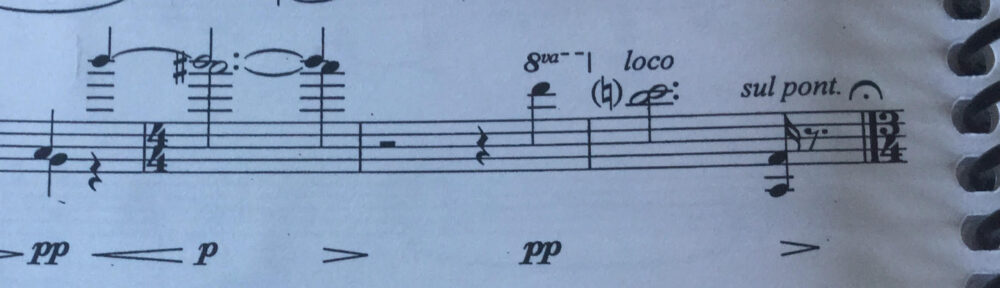
I have performed eleven works by Michael Hersch so far. He has a grippingly expressive musical language and poignant sense of harmony. The solo violin piece titled “the weather and landscape are on our side” – written for me – conveys hefty emotional substance through particularly delicate and subtle means. There are a few loud outbursts, but it is mostly very eerie and sometimes whispers on the edge of silence. In this piece, he used certain non-pitched string techniques for the first time and, also for the first time, has the violinist briefly sing while playing, rather similarly to the Luigi Nono piece I play, La lontananza nostalgica utopica futura. Michael’s piece also involves playing extremely high pitches and close intervals, very quietly.
His piano music stems from his remarkable and idiosyncratic ability as a pianist. Michael performs infrequently, but his playing is displayed on the documentary film “The Sudden Pianist”. His piano writing exploits the inherently massive power of the instrument and makes innovative use of the pedals, along with a wide variety of articulations. The built-in time/space (silences and phrase lengths) in his music allows for chords to shoot into the air and literally hang there vibrating for long seconds, so that we listen as the pitches within harmonies move around kaleidoscopically and slowly dissolve at various rates. The dimensions of the instrument’s sound-producing capacity and the variety he draws from within that sound suit his wish to write large-scale works that take advantage of its extremes.
He has also written a great deal of solo and chamber music for strings. These pieces often feature frenzied chordal and double-stop playing, use of the bright open strings, and tumultuous fast movements like in his piano works. There is a particular emphasis on harmony, on sustained chorale-like polyphony and the throbbing vibration of notes against each other. He stipulates a sound that is non-vibrato or using vibrato sparingly. In quiet music, subtly adjusted degrees of pressure or lightness can be used to produce varied gradations of dynamics below the basic piano/pianissimo threshold. With this approach, the player can dissipate the core of the tone so that it tends toward the fragile and intimate. There is only so long a resonance or loud an attack that any stringed instrument will produce, but the variety and range of nuances of bow friction can be infinite.

