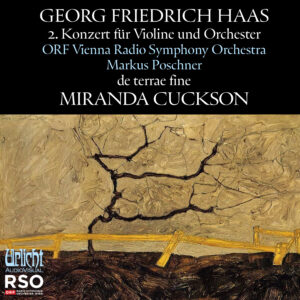
On November 21, my new album of Georg Friedrich Haas’s music is released in digital and CD formats on the Urlicht label. The album features the Violin Concerto No. 2 and de terrae fine for solo violin. The concerto is my live performance in November 2023 at the Vienna Musikverein with the ORF Vienna Radio Symphony and conductor Markus Poschner, which was broadcast live on Ö1 Radio. The de terrae fine recording is reissued from my earlier Urlicht album Melting the darkness.
— We are very honored that the album was named an “apex” favorite recording of the year by music critic Alex Ross. —
The Concerto is a hugely meaningful piece to me personally and as a musician. I’ve written before about the dedication to my grandfather. Georg is an astounding artist and I’m so very moved and extremely grateful to him for this work. Thank you to the brilliant Vienna RSO and Markus Poschner, and to all the orchestras, conductors, and presenters who have given wonderful performances of this concerto with me, including at its 2017 premiere. My profuse thanks to producer Gene Gaudette for his perseverance issuing this recording and his steadfast support, enthusiasm, and good communication in many projects over the years.
Below, I’m sharing the long version of my liner notes, with my thoughts and feelings about the two pieces, in fuller depth and detail. The liner note that comes with the album – and that will be available as a pdf on the Urlicht website – says a lot of the same things but in a more distilled way, in case you’d rather listen without reading this much about it.
The cover art, chosen by me, is “Bare Tree behind a Fence”, painted in 1912 by Austrian artist Egon Schiele.
As anyone who knows Georg can tell, joy and togetherness are very important to him (and likewise to me), but there’s also a lot of truth and catharsis in expressing the existential crises in human experience. I’m deeply grateful to share this music with you, through my playing and this recording.
***********
With this album, Georg Friedrich Haas and I are very happy to share two very important pieces of music from our years of friendship and collaboration: his Violin Concerto No. 2 (2017) and de terrae fine (2001) for solo violin.
Georg is a masterful creator of sonic experience, a craftsman who puts elements of music into motion with waves of vibrations and rhythmic flux, and a great novelist’s sense of large-scale pacing and accumulating, shifting layers. In his compositions, sophistication is allied with simplicity and the deep psychological and emotional sources he accesses with his music.
His melodic/harmonic language – his use of microtonality – awakens the ears and imagination to the richness of expression in the nuanced distances between notes. This musical language is very specific while feeling and sounding extremely organic. This is because it’s based in the physical properties of sound, the overtone series, and the intrinsic throbbing of vibrations and harmonies which we can feel and hear.
Georg is a Romantic composer. His music’s essential romanticism is felt in its connection to the bodily senses and the nature of sound; its very personal approach to form, the music taking whatever shape it needs to serve the expression; its exploration of the inner self and connection; and its acutely intense emotional states, whether of sadness, longing, hope, despair, anger, joy, or nostalgia.
I’ve played de terrae fine live many times since meeting Georg in 2009, and I recorded it for my album Melting the Darkness (on the Urlicht label). It was at the release concert for that album that Georg said he wanted to write a concerto for me. The work was co-commissioned by the Tokyo Symphony, Staatsorchester Stuttgart, and Orchestra of Casa da Musica Porto. Subsequently I performed it in Austria, including the performance on this recording with the Vienna Radio Symphony and Markus Poschner at the Musikverein. This powerfully moving piece is in dialogue with the Violin Concerto by Alban Berg, expanded into microtonality and a form for the modern story in sound that Georg wanted to tell.
In the Violin Concerto No. 2 and de terrae fine, the solo violin is an individual protagonist but in drastically different scenarios. The solo and orchestral mediums are used to express crises internal and external: de terrae fine is an emotional and existential drama, whereas the concerto suggests an epic journey across physical terrain amid social upheaval.
Georg composed de terrae fine in 2001 during a sabbatical on the Irish coast. At the time, he was mired in personal conflict and depression, and the piece’s title, meaning “from the end of the earth”, refers to his physical location – at land’s end by the Atlantic ocean – and to a devastating feeling of isolation and sadness. The piece is essentially an expression of a state of mind, uttered perhaps entirely within the self, or to the surrounding, enveloping silence. The silence is not just the intrinsic container for the music to exist in, it’s charged with significance as an inescapable solitude of the mind or self.
de terrae fine is remarkable for its extremely gradual build of moment-to-moment tension between, on the one hand, a subdued feeling of futility and, on the other, a desperate need to give voice to the inner experience. Solo violin pieces often involve a lot of chords and double-stops, but here, much of the piece is a winding, beautifully melancholy, single line of microtones. Each interval seems to trace the twinges in a lonely, anguished train of thought.
As this rumination continues, there’s now and then a long, sighing double-stop or harmonic, or a wistful brush of sliding, feather-light arpeggios, or a loud, angrily smeared chord. These surges of plaintive emotion become more frequent, and suddenly about two-thirds through the piece, the feeling of despair gives way to a fragile nostalgia, with a startlingly sweet melody of double-stopped thirds. From this point, the chords and arpeggios fully erupt, frantically piling upward and reaching a raging frenzy – followed by exhaustion as a few utterances retreat into silence.
In the Violin Concerto No. 2, the music seems to yearn toward melody and warmth but is continually disrupted by disturbing, sometimes violent forces. The orchestra comprises full strings (sometimes one player per part), winds, and brass, plus percussion, harp, and accordion. The concerto experiments with changing relations between individuals and the collective, and groups within it: combining the instruments as one or as protagonist and response; at one point fully submerging the solo violin in the orchestral sound; at other times having the full orchestra play extremely quietly with the soloist.
Microtonal harmonies ripple across the many arpeggios and scales, and speeds change tumultuously, sometimes in oppositional layers. Amid these storms, the solo violin’s occasional songlike fragments are exposed and poignant.
The Violin Concerto No. 2 is in nine continuous movements: Praeludium, Kadenz, Resonanz und Feedback, Dreistimmige Invention, Sgraffito, Sotto voce, Interludium, just intonation, and Aria.
The piece opens with large orchestral swells of harmony, like ocean waves, or like massive social dynamics in flux. The solo violin is part of these waves, then breaks away into a cadenza-like movement with tremendous urgency and determination. The orchestra re-asserts, challenging the violin’s sweeping passages with loud crashes and frenetic quivering. Like the opening of the second movement of Alban Berg’s Violin Concerto (1935), this Kadenz has an alarm-bell sense of dire emergency, verging on wild chaos.
The following three-movement sequence – Resonanz und Feedback – Dreistimmige Invention – Sgraffito – is the core of the concerto and draws on the ending of the Berg Concerto. In the final Adagio of that piece, Berg famously quotes Johann Sebastian Bach’s setting of the chorale Es ist genug. Berg has the solo violin play the melody and spin it into a fantasia that is gradually joined by the violins of the orchestra, culminating in playing en masse in unison. As they depart again, the solo violin floats heavenward to the end.
In Haas’ Resonanz und Feedback, the violin plays darkly lyrical fragments and taut long tones, which are taken up by the orchestra like a reverberation. They then introduce slowly accelerating, brooding arpeggios and the solo violin joins as they climb, becoming the central voice as the strings play along in unison like a luminous aura.
This builds in heft and density, culminating at the Dreistimmige Invention, an agonizingly tense counterpoint between three instrumental groups. Each line of counterpoint is actually a braid of microtonal clusters. The title “Three-voice invention” distinctly suggests the keyboard Inventions by Bach and also, quite likely, the Invention forms in Act III of Berg’s opera Wozzeck (1922).
“Sgraffito” is an artistic technique of scraping through a surface to reveal the layer beneath.
Here in Haas’ Sgraffito, the solo violinist is initially – as in the Berg Concerto ending – inaudible within the orchestra texture. As the layers thin out, the solo violin re-emerges playing tender, melodious scales. The violin murmurs and sings to itself, Sotto voce, accompanied by gently clattering percussion.
At the Interludium, the threatening orchestral waves are back, the solo violin defying the danger by leaping into the turmoil from an extreme height. This finally subsides into an oasis of suspended stillness: a just intonation sound-world of glowing harmonies and a sweetly-tuned melody in double-stopped thirds by the soloist. These vividly recall the melody in thirds in de terrae fine, which appeared in that piece like a haunted, frail memory. Here in the concerto, they arrive with a feeling of peace, perhaps of hope, and introspective quiet.
The return to perilous reality is signaled by the start of a slow drum pulse. Pushing and pulling against the drumbeats and the unstable tempo, the solo violin launches into a volatile Aria – surges of jagged melody and arpeggios that veer precipitously between high to low. The drum pulse ultimately accelerates and hurtles to the end and an unknown future.