Georg Friedrich Haas album: Violin Concerto No. 2 and de terrae fine


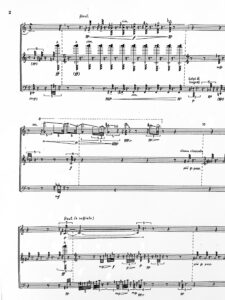
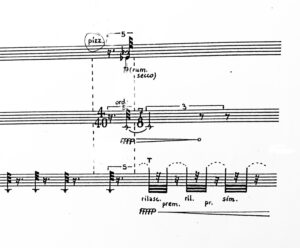
On November 21, my new album of Georg Friedrich Haas’s music is released in digital and CD formats on the Urlicht label. The album features the Violin Concerto No. 2 and de terrae fine for solo violin. The concerto is my live performance in November 2023 at the Vienna Musikverein with the ORF Vienna Radio Symphony and conductor Markus Poschner, which was broadcast live on Ö1 Radio. The de terrae fine recording is reissued from my earlier Urlicht album Melting the darkness.

— We are very honored that the album was named an “apex” favorite recording of the year by music critic Alex Ross. —

The Concerto is a hugely meaningful piece to me personally and as a musician. I’ve written before about the dedication to my grandfather. Georg is an astounding artist and I’m so very moved and extremely grateful to him for this work. Thank you to the brilliant Vienna RSO and Markus Poschner, and to all the orchestras, conductors, and presenters who have given wonderful performances of this concerto with me, including at its 2017 premiere. My profuse thanks to producer Gene Gaudette for his perseverance issuing this recording and his steadfast support, enthusiasm, and good communication in many projects over the years.

Below, I’m sharing the long version of my liner notes, with my thoughts and feelings about the two pieces, in fuller depth and detail. The liner note that comes with the album – and that will be available as a pdf on the Urlicht website – says a lot of the same things but in a more distilled way, in case you’d rather listen without reading this much about it.

The cover art, chosen by me, is “Bare Tree behind a Fence”, painted in 1912 by Austrian artist Egon Schiele.

As anyone who knows Georg can tell, joy and togetherness are very important to him (and likewise to me), but there’s also a lot of truth and catharsis in expressing the existential crises in human experience. I’m deeply grateful to share this music with you, through my playing and this recording.

***********

With this album, Georg Friedrich Haas and I are very happy to share two very important pieces of music from our years of friendship and collaboration: his Violin Concerto No. 2 (2017) and de terrae fine (2001) for solo violin.

Georg is a masterful creator of sonic experience, a craftsman who puts elements of music into motion with waves of vibrations and rhythmic flux, and a great novelist’s sense of large-scale pacing and accumulating, shifting layers. In his compositions, sophistication is allied with simplicity and the deep psychological and emotional sources he accesses with his music.

His melodic/harmonic language – his use of microtonality – awakens the ears and imagination to the richness of expression in the nuanced distances between notes. This musical language is very specific while feeling and sounding extremely organic. This is because it’s based in the physical properties of sound, the overtone series, and the intrinsic throbbing of vibrations and harmonies which we can feel and hear.

Georg is a Romantic composer. His music’s essential romanticism is felt in its connection to the bodily senses and the nature of sound; its very personal approach to form, the music taking whatever shape it needs to serve the expression; its exploration of the inner self and connection; and its acutely intense emotional states, whether of sadness, longing, hope, despair, anger, joy, or nostalgia.

I’ve played de terrae fine live many times since meeting Georg in 2009, and I recorded it for my album Melting the Darkness (on the Urlicht label). It was at the release concert for that album that Georg said he wanted to write a concerto for me. The work was co-commissioned by the Tokyo Symphony, Staatsorchester Stuttgart, and Orchestra of Casa da Musica Porto. Subsequently I performed it in Austria, including the performance on this recording with the Vienna Radio Symphony and Markus Poschner at the Musikverein. This powerfully moving piece is in dialogue with the Violin Concerto by Alban Berg, expanded into microtonality and a form for the modern story in sound that Georg wanted to tell.

In the Violin Concerto No. 2 and de terrae fine, the solo violin is an individual protagonist but in drastically different scenarios. The solo and orchestral mediums are used to express crises internal and external: de terrae fine is an emotional and existential drama, whereas the concerto suggests an epic journey across physical terrain amid social upheaval.

Georg composed de terrae fine in 2001 during a sabbatical on the Irish coast. At the time, he was mired in personal conflict and depression, and the piece’s title, meaning “from the end of the earth”, refers to his physical location – at land’s end by the Atlantic ocean – and to a devastating feeling of isolation and sadness. The piece is essentially an expression of a state of mind, uttered perhaps entirely within the self, or to the surrounding, enveloping silence. The silence is not just the intrinsic container for the music to exist in, it’s charged with significance as an inescapable solitude of the mind or self.

de terrae fine is remarkable for its extremely gradual build of moment-to-moment tension between, on the one hand, a subdued feeling of futility and, on the other, a desperate need to give voice to the inner experience. Solo violin pieces often involve a lot of chords and double-stops, but here, much of the piece is a winding, beautifully melancholy, single line of microtones. Each interval seems to trace the twinges in a lonely, anguished train of thought.

As this rumination continues, there’s now and then a long, sighing double-stop or harmonic, or a wistful brush of sliding, feather-light arpeggios, or a loud, angrily smeared chord. These surges of plaintive emotion become more frequent, and suddenly about two-thirds through the piece, the feeling of despair gives way to a fragile nostalgia, with a startlingly sweet melody of double-stopped thirds. From this point, the chords and arpeggios fully erupt, frantically piling upward and reaching a raging frenzy – followed by exhaustion as a few utterances retreat into silence.

In the Violin Concerto No. 2, the music seems to yearn toward melody and warmth but is continually disrupted by disturbing, sometimes violent forces. The orchestra comprises full strings (sometimes one player per part), winds, and brass, plus percussion, harp, and accordion. The concerto experiments with changing relations between individuals and the collective, and groups within it: combining the instruments as one or as protagonist and response; at one point fully submerging the solo violin in the orchestral sound; at other times having the full orchestra play extremely quietly with the soloist.

Microtonal harmonies ripple across the many arpeggios and scales, and speeds change tumultuously, sometimes in oppositional layers. Amid these storms, the solo violin’s occasional songlike fragments are exposed and poignant.

The Violin Concerto No. 2 is in nine continuous movements: Praeludium, Kadenz, Resonanz und Feedback, Dreistimmige Invention, Sgraffito, Sotto voce, Interludium, just intonation, and Aria.

The piece opens with large orchestral swells of harmony, like ocean waves, or like massive social dynamics in flux. The solo violin is part of these waves, then breaks away into a cadenza-like movement with tremendous urgency and determination. The orchestra re-asserts, challenging the violin’s sweeping passages with loud crashes and frenetic quivering. Like the opening of the second movement of Alban Berg’s Violin Concerto (1935), this Kadenz has an alarm-bell sense of dire emergency, verging on wild chaos.

The following three-movement sequence – Resonanz und Feedback – Dreistimmige InventionSgraffito – is the core of the concerto and draws on the ending of the Berg Concerto. In the final Adagio of that piece, Berg famously quotes Johann Sebastian Bach’s setting of the chorale Es ist genug. Berg has the solo violin play the melody and spin it into a fantasia that is gradually joined by the violins of the orchestra, culminating in playing en masse in unison.  As they depart again, the solo violin floats heavenward to the end.

In Haas’ Resonanz und Feedback, the violin plays darkly lyrical fragments and taut long tones, which are taken up by the orchestra like a reverberation. They then introduce slowly accelerating, brooding arpeggios and the solo violin joins as they climb, becoming the central voice as the strings play along in unison like a luminous aura.

This builds in heft and density, culminating at the Dreistimmige Invention, an agonizingly tense counterpoint between three instrumental groups. Each line of counterpoint is actually a braid of microtonal clusters. The title “Three-voice invention” distinctly suggests the keyboard Inventions by Bach and also, quite likely, the Invention forms in Act III of Berg’s opera Wozzeck (1922).

“Sgraffito” is an artistic technique of scraping through a surface to reveal the layer beneath.
Here in Haas’ Sgraffito, the solo violinist is initially – as in the Berg Concerto ending – inaudible within the orchestra texture. As the layers thin out, the solo violin re-emerges playing tender, melodious scales. The violin murmurs and sings to itself, Sotto voce, accompanied by gently clattering percussion.

At the Interludium, the threatening orchestral waves are back, the solo violin defying the danger by leaping into the turmoil from an extreme height. This finally subsides into an oasis of suspended stillness: a just intonation sound-world of glowing harmonies and a sweetly-tuned melody in double-stopped thirds by the soloist. These vividly recall the melody in thirds in de terrae fine, which appeared in that piece like a haunted, frail memory.  Here in the concerto, they arrive with a feeling of peace, perhaps of hope, and introspective quiet.

The return to perilous reality is signaled by the start of a slow drum pulse. Pushing and pulling against the drumbeats and the unstable tempo, the solo violin launches into a volatile Aria – surges of jagged melody and arpeggios that veer precipitously between high to low. The drum pulse ultimately accelerates and hurtles to the end and an unknown future.


Sciarrino, harmonics, Paganini, Mendelssohn, and the otherworldly


Last week, I participated in this conference about the music of Salvatore Sciarrino, at the Orpheus Institute in Ghent, Belgium. Organized by violinist Marco Fusi, the conference was titled “Come vengono prodotti gli incantesimi?” after a piece by Sciarrino. It featured sixteen presenters – devoted and passionate performers of this music and insightful thinkers – most of whom I met there for the first time. I enjoyed how many perspectives on this music were explored and the very interesting and warm exchange of ideas and questions. Thanks to New School University for the grant supporting my travel for this event.

My paper/presentation is about violin (stringed-instrument) harmonics in Sciarrino’s music, about the idea of the otherworldly and venturing to the beyond, and his music’s connection to Mendelssohn and Paganini. I first played Sciarrino’s Six Caprices for solo violin over twenty years ago. In 2017, I was asked by the West Cork Chamber Music Festival to perform all six. In 2020 during the Covid pandemic, I made videos of them and wrote briefly about harmonics and about a Mendelssohnian inspiration. From that work, I had ideas about the pieces stirring in my mind and, thanks to Marco Fusi and this conference, I was glad to take this opportunity to give them form and to talk about my thoughts and approach.  I much enjoyed doing some research, rethinking it, and writing my paper, and what I came up with further supported my feeling about this music.

Below is the text of my talk. I also showed these videos and played some short live demonstrations, which I include here as video clips.

Notes and noises, chance and choices.. Violin harmonics in Sciarrino’s music

The subject of my talk today is, essentially, violin harmonics (or stringed-instrument harmonics) in Salvatore Sciarrino’s music, the interpretation and playing of them, and their relation of pitch and non-pitch, and choice and chance. This conference’s title – “How are spells produced?” – concisely addresses the otherworldly qualities of Sciarrino’s music and the practical questions of playing it.  Later in this presentation, I will discuss technical questions, demonstrate examples, and look at two of the various works of his that I’ve played – the Sei Capricci and Omaggio a Burri. While getting to that, I’d like to discuss connections between Sciarrino’s harmonics and a couple more philosophical threads in his work, which I feel have a bearing on interpreting these compositions. One is the idea of the “otherworldly”- a parallel world or a world beyond. The other is Sciarrino’s dialogues with the music of Mendelssohn and Paganini. 

Listeners to Sciarrino’s music often describe it as “ghostly”,“magical”, “spell-binding”, or “mysterious”.  Since his early works in the 1960s and 70s, Sciarrino’s work has been very much about perception, our perception of sound and space. Much of his music operates at the edge of audibility, expanding our awareness and heightening our sensitivity to its detailed range of quiet dynamics, its silences, and its breathy, airy, sighing, rustling, and scurrying sounds. This extremely vivid world of sound and silence naturally conjures a feeling of mystery and the unknown, as it provokes startled questions within us as we listen. Where are those sounds coming from? What’s going to happen next?  His musical syntax and timing also make his music feel especially unpredictable. The occasional loud outbursts can be shocking.

A frequent gesture in his works is a wave-like phrase that emerges from and returns to “niente” – to nothing. Sciarrino’s philosophy of silence draws us into an alternate, flip-side world. Instead of silences being respites or pauses in a world of sound, in Sciarrino’s world the natural fundamental condition is silence. Sounds then appear out of the silence and make their presence felt, like sea creatures lifting their heads into the air, breaking the surface of the ocean. The ocean of course remains one of the great mysteries of our planet, still vastly unexplored.

Sciarrino has developed new techniques, and explored less common ones, on many instruments. On the violin, one of the devices he has used most is harmonics. Harmonics are a physical phenomenon of high overtone pitches produced by lightly touching a string at one of the nodes that divides the string length in proportion to its fundamental. Whether the fundamental is an open string or a note stopped with a finger, the system of partials functions the same.

In a rehearsal documentary from 2023, Sciarrino said:

“We talk about what we perceive as a limit and that becomes instead the opening of the border. I mean, the boundary is something that opens, not something that closes. What we perceive from the inside as an end, it’s actually the beginning of the earth, the beginning of the world and this is, in my opinion, a very important perspective also for understanding today’s phenomena that otherwise plague us. They are incomprehensible or disturb us because they seem to change the order of the world. No! They are the real order of the world.” [1]

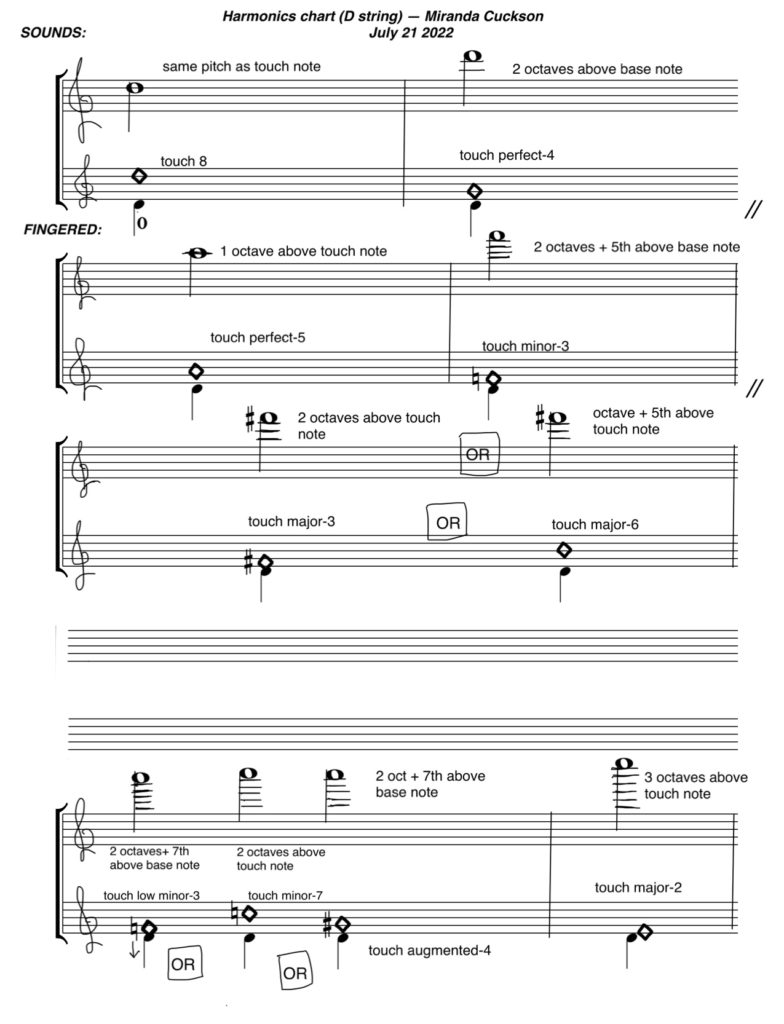
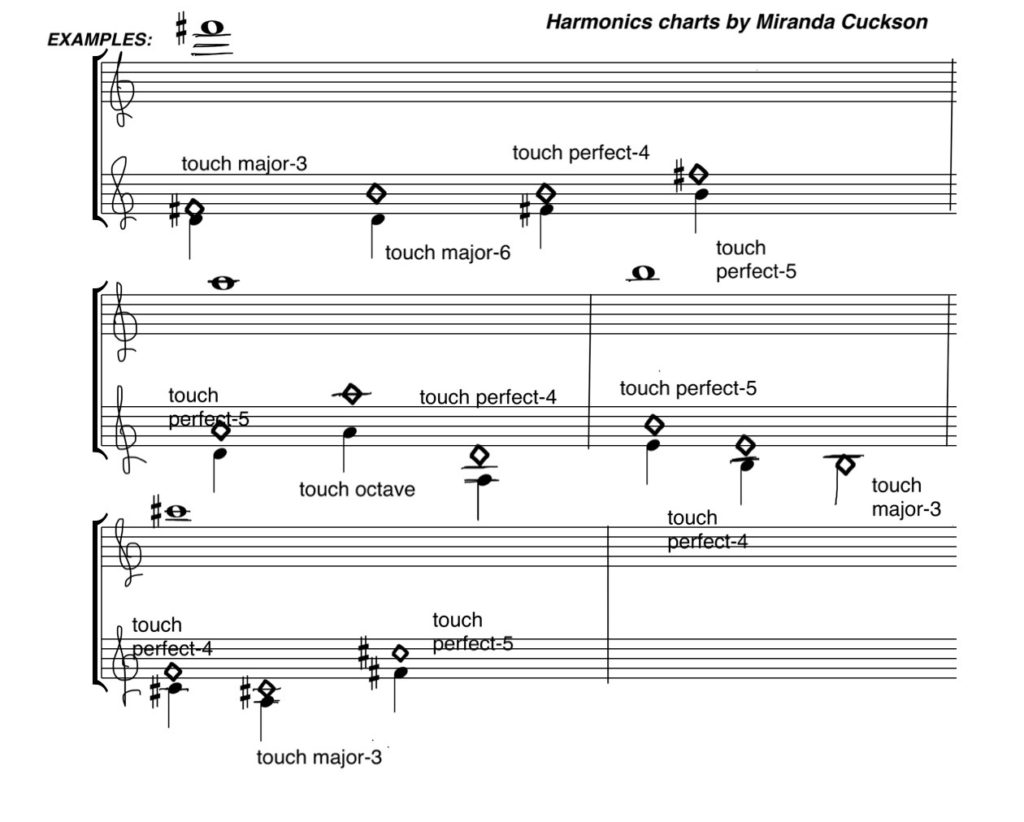
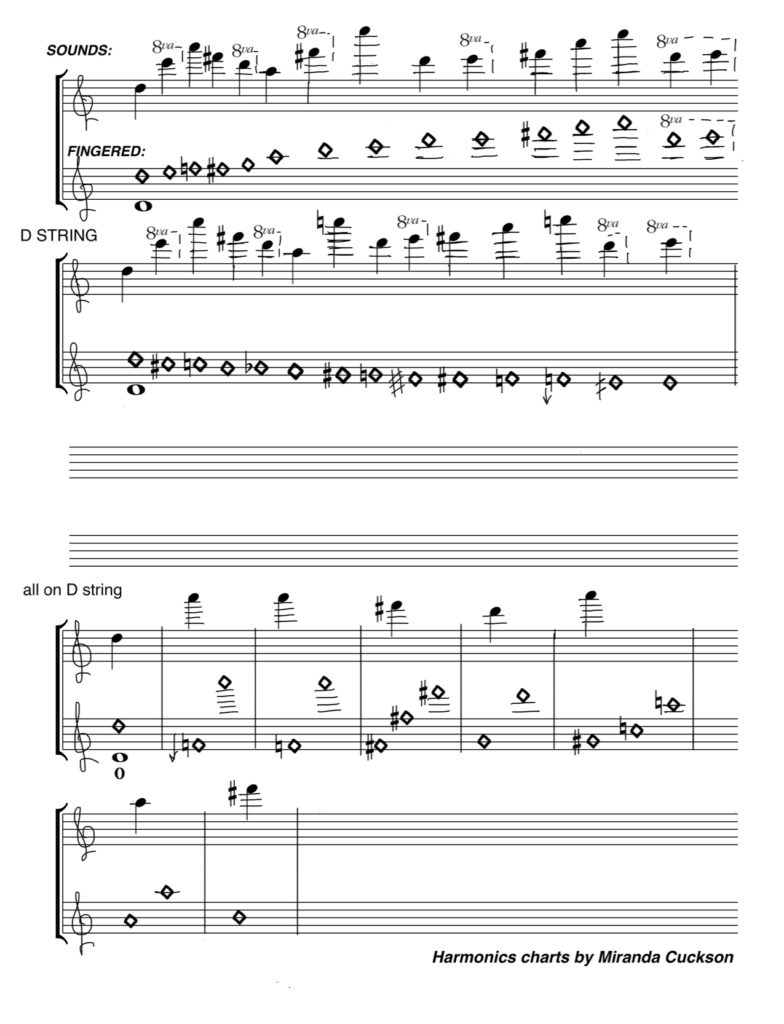
Harmonics are an absolutely integral physical feature of the instrument itself. They are, in essential ways, the “real order” of the violin. However, the full system of harmonics, including practical knowledge of where the nodes are on the string and what pitches they will produce, is not taught in any methodical way by most violin teachers. I believe the reason is that the violin has been traditionally so valued as a cantabile instrument, cherished for its melodic qualities. Young violinists usually encounter a harmonic as a single effect in a piece: a flamboyant flourish at the end of a phrase or a feathery note in a slow passage. Once the player has learned to produce that effect, they’re left to figure out other harmonics on their own. In response to this, a few years ago I made some charts about harmonics, which I posted on my social media and website.

The first page shows harmonics by the interval between fundamental and node (3rd, 4th, 5th harmonics etc), focusing mainly on those most often used and that resonate most easily. The next charts show equivalent harmonic fingerings, and the entire series of partials, including the far less commonly used ones, moving both up and down the string (here the D string).

The harmonics system is the alternative reality of the violin, less known and understood than its usual solid-toned world. Harmonics World is not a world of chaos, it functions according to its own laws and logic, much as there are rules and formulas to the magic and books of spells in many fantasy tales, such as those of Harry Potter, the Lord of the Rings, Narnia, Alice in Wonderland, and so on. 

Visually, a page of harmonics even looks like the immaterial spirits of music, with its empty diamond note-heads. Lucia D’Errico writes “memory is explored [in] the cultural memory of sounds..Using traditional instruments.. Sciarrino explores their sonic peripheries.” [2]

Sciarrino calls himself an autodidact and seems to have studied in a very independent way from a young age. Much of what he apparently chose to study was the core classical repertoire: Mozart, Mendelssohn, Beethoven, Brahms. Throughout his music since, there have been many pieces in dialogue with past composers, such as Mozart, Stradella, Gesualdo, and Scarlatti. These can be arrangements, or what he calls “elaborations”, or fragments.

Asked about this, he said: “There are moments of strong hybridization between them. They are not quotations, they are part of me… These people are not figures, they are friends.” [1]

Sciarrino’s Sei Capricci from 1976 were composed for Salvatore Accardo and they reference the 24 Caprices by Niccolo Paganini. Paganini was an awe-inspiring virtuoso, who amazed his audiences to the extent they claimed he had made a pact with the Devil. In choosing Paganini’s Caprices as inspiration, Sciarrino was looking to a model of virtuosity that would feature Accardo, but he was likely attracted also to the sense of the otherworldly about Paganini, the mystery around him and the sense of a different, magical world, of which his playing provided a glimpse.

Paganini was known for the dazzling tricks in his playing, such as left-hand pizzicato, high passagework, and staccato and jeté bowing. It’s significant, though, that harmonics are not an especially frequent effect in Paganini’s music. There are actually no harmonics notated in his 24 Caprices, and not that many in his other compositions. The most substantial instance is the melody played as double-stopped harmonics in the 3rd movement of his first Violin Concerto. 

It’s important to remember, along with Paganini’s daredevil image, that he was friends with Rossini and his music came out of the bel canto opera, with the dolce cantabile of its melodies and theatrical rhetoric of the aria. I believe that some of Paganini’s virtuosic techniques truly mimic the operatic singer: the chromatic glissando [chromatic glissando] and the on-the-string slurred staccato have much the same articulated effect as fast coloratura passages.


I’ll talk about each of Sciarrino’s Six Caprices, but to focus on his Caprice No. 1 for a moment: This Caprice opens the set with its most obvious reference – its jeté arpeggios clearly mirror those in Paganini’s Caprice No. 1. 

Paganini Caprice #1

In Sciarrino’s caprice, Paganini’s world is flipped into an alternative state: the solid notes in the Paganini are transformed into harmonics, and the consistent up-down direction of Paganini’s jeté arpeggios turns erratically topsy-turvy, sometimes going up-down and sometimes down-up. 

Meanwhile, Sciarrino still throws in a solid note here and there. By doing that, I feel he is maintaining a polarity between the more flesh-and-blood world of the Paganini and the ghostly one of his harmonics, showing that these two planes co-exist. Therefore, I feel it’s important for the performer to differentiate those sounds clearly, and to move between them with naturalness.

This is from a series of videos I made in 2020, of the Six Caprices.


Paganini’s importance as an inspiration to Sciarrino is clear, but I believe the influence of Paganini was also filtered through that of Felix Mendelssohn. Paganini published his Caprices in 1820, when Mendelssohn was 11 years old. Mendelssohn was an extremely prodigious talent. Like Paganini, he himself had a quality of the otherworldly, of the magical and awe-inspiring. But, whereas Paganini’s persona provoked some feelings of danger or suspicion, Mendelssohn’s mainly suggests radiance, naturalness, and a kind of sincere passion. 

His Violin Concerto in E minor, written in 1844, has many sparkling moments, but a special passage – famous now but probably very beguiling when first heard – is at the end of the first movement cadenza, when the solo violin plays jeté arpeggios that turn into an accompaniment to the orchestra’s melody. This moment recalls Paganini’s Caprice No. 1.

Mendelssohn’s significance to Sciarrino is evident in another work that he wrote for Accardo, in 1985: the concerto titled Allegoria della Notte. This startling piece toggles between Sciarrino’s music and sections from Mendelssohn’s Violin Concerto. The fragments from Mendelssohn are altered by Sciarrino but are still very recognizable. At the end of the cadenza, high harmonic arpeggios usher in the return of the orchestra, evoking the parallel moment in the Mendelssohn.

Mainly through the dramatic splicing of the contrasting materials, Sciarrino’s concept of parallel worlds becomes very explicit in this piece. His program note says:
“Imagine listening to Mendelssohn’s Violin Concerto. Amidst the flashes of consciousness (or the intermittencies of memory) emanates another music, literally generated from the echo of a lyrical impulse. Extending indefinitely, this echo makes perceptible another, parallel space: the uninhabited other side of the Mendelssohn planet.” This is the very beginning of Sciarrino’s concerto, played by Accardo. 


I’ve focused on Paganini and Mendelssohn because I feel that the conversation – and shared qualities – among Sciarrino, these past composer “friends”, and his living friend Accardo, form an important context for these pieces. In Sciarrino’s musical echoes of Mendelssohn and Paganini, the sound of resonating notes is a remnant and link to a cultural past, and in his use of harmonics, there is, along with an otherworldliness, a quality of radiance and sweetness, a memory of song and dance and human warmth.

Sciarrino makes use of many types of harmonics. Besides the more common ones, he often uses harmonics on the E string, with the stopped finger on a note that’s already quite high. The resulting pitches are so high, people often aren’t accustomed even to hear them as pitches. [very high harmonics, on C#] He sometimes also has notes fingered extremely high on the string, fingers placed beyond the fingerboard, near the bow in what I call “rosin territory”. [demo beyond fingerboard] The effect is again a sense of traveling to the beyond. These notes reach the edge of physical possibility and start to disappear into the mysterious realm of the inaudible.

Harmonics are affected by the same triumvirate of bowing variables that affect all bowed notes – speed, pressure, and placement on the string. Add accurate left-finger placement to that and you have the necessary factors for good-sounding pitch, factors that have higher stakes with harmonics. Along with the logical, mathematical system of partials, the flip-side of harmonics is that they are delicate, vulnerable, and especially dependent on factors that can affect the vibration of the string. There is always some element of exciting virtuosic risk. 

This comes into play especially with the harmonics that don’t speak as immediately, like 3rd harmonics, or when harmonics are played in succession at speeds that don’t give time for the partial to be activated. Bow strokes such as jeté or “spazzolare” can add a degree of chance because of how they interact with the string. With his interest in peripheries and thresholds of perception, Sciarrino welcomes the elements of chance by using harmonics so prevalently. Chance can be an aesthetic factor at the thresholds in the spectrum of sound from silence to breath to noise to pitch. 

Sciarrino’s Caprice No. 2 consists of double-stop harmonics with tremolos, which clearly recall the double-stop tremolos in Paganini’s Caprice No. 6.  Paganini’s caprice has one long, sustained melody supported by continuous tremolos on the other string. Paganini Caprice #2

 In Sciarrino’s world, the sustained line is fragmented into wave-like phrases, glimmering notes becoming discernible and returning again and again to silence.

The tremolo moves continually from one string to another. A particular technical aspect is the releasing of the lower finger of the tremolo so that it can produce another harmonic, rather than keeping it pressed down like the low note of a trill. This way, Sciarrino is able to involve a greater number of pitches in these gestures. Again I feel that endeavoring to produce the pitches of these harmonics is meaningful, because it connects the piece to a memory of the dolce cantabile, and it also ties together moments of this caprice with a feeling of peaceful return.

Caprice No. 3 involves a bow technique that he calls “spazzolare” or brushing, a diagonal sort of motion across the strings like a car’s windshield wiper.  Sciarrino spazzolare

Here the bow stroke introduces a strong aleatoric element and inevitably obfuscates the pitches. If fingered accurately, the harmonic pitches will tend to pop out of the busy texture at unpredictable moments. (I quite like this performance, but I now play this caprice with a wider brushing motion.)

The Paganini corollary isn’t obvious, but it could be his Caprice No. 2 or No. 11. If the wide, vertical string-changing bow movements in the Paganini are turned horizontal, they perhaps become the “spazzolare” wiping of the bow in the Sciarrino. Paganini Caprice #11

Sciarrino’s Caprice No. 4 features a gesture of jeté harmonics in, mostly, sextuplets. These recall the groups of four upbeat 32nd-notes in Paganini’s Caprice No. 9
Paganini Caprice #9

and similarly the last movement of Paganini’s first Violin Concerto.
Paganini Violin Concerto #1 3rd mvt

In those pieces, the groups of four have a strong rhythmic identity and melodic contour. I feel in the Sciarrino, the sextuplets are similarly motivic and should be heard clearly as sextuplets.

In Caprice No. 5, the primary effect is unisons played as harmonics with different fingerings. These produce slight timbral differences, and when alternated quickly, the notes start to merge, rather like when fast-moving blades of a fan blur together. While he calls this caprice “un suspiro” or breath, the effect of the unisons is quite melodic, since there’s time to hear the pitches.

This caprice is similar to Paganini’s No. 12 which has a bariolage bowing across two strings. Paganini Caprice #12

Caprice No. 6 is a compendium of ideas from the previous caprices, and a greater feeling of looseness comes into it.  There are longer jeté’s of harmonics that feel more indeterminate and gestural. There are simultaneous harmonic trills on two strings, which are simpler to play than the trills in Caprice No. 2. And a “danzando” middle section is a cheerful Mendelssohnian scherzo in natural harmonics.


Not all compositions in Sciarrino’s large catalogue approach harmonics the same way. Allegoria della Notte and his Piano Trio No. 2 use fewer harmonic overtones and put more emphasis on fingerings in the extreme high register. His recent Sei Nuovi Capricci e un Saluto for violin uses harmonics, but nearly as often, solidly-fingered notes. However, in other pieces, harmonics are modified to bring out more noise than pitch. 

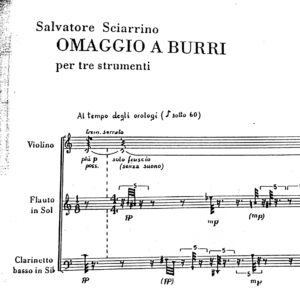
His Omaggio a Burri for flute, clarinet, and violin is a memorial piece to the painter and sculptor Alberto Burri, who died that year, in 1995. Burri was very occupied with physical texture. His artworks explored paint, tar, sand, wood, stone, plastics, metals, and coarse fabrics like jute and burlap. He used fire to make charred surfaces and affixed jutting objects to his paintings.

Sciarrino’s interests have also meant investigating the physical surfaces of instruments and the sounds resulting from interaction with their textures. Harmonics are, by definition, played on the surface of the string. At the beginning of Omaggio a Burri, Sciarrino writes for the violin “as soft as possible, only rustling, no sound”. Though notated as a 5th-harmonic on D, the intention is clearly just the friction of hair rubbing against the dampened string.


This friction is similar to the toneless friction of air fluttering across a surface. When the flute erupts with loud multiphonics, the violin joins with harmonics that merge with the flute’s tone. Later, the violin plays a quiet harmonic sigh, marked “flute-like, blown”. Essentially, in this piece Sciarrino uses the surfaces of the violin to turn it into a sort of wind instrument.  The violinist even plucks a pizzicato harmonic, marked “dry noise”, to make a dull thud that sounds like a flute tongue-ram.

With his fascination with perception and thresholds, Sciarrino leads us to venture into other worlds, or to listen intently from afar and contemplate what’s over there in the beyond. In that recent documentary, he said:

“Freedom is the ability to choose. In my opinion, there is no freedom if you don’t have the opportunity to choose… If you choose between “this” and “this”, then you are free. I mean, you need to make reality concrete because, in my opinion, freedom is taking one thing and leaving another.”

Sciarrino recognizes that knowing the reality of the world one is in, means knowing that there is another real world somewhere else.


[1] Opoficio Sonoro. “Promenade Sciarrino” April 4, 2023. https://www.youtube.com/watch?v=r9W2D-HQ84I

[2] Lucia D’Errico. Powers of Divergence: An Experimental Approach to Music Performance. (Leuven University Press, 2018)

interdisciplinary artists

Last year I participated with AMOC* in a lovely visit to a high school in New Haven. There was a nice article in a local paper about it.

I’ll add to that comment of mine in the article –
I’m as dedicated as ever to music’s expression in itself – that is, without words or narrative or visuals. The inner workings of music itself are powerful, both in motion and structured, and full of expressions that transcend verbal or visual language, in myriad and sometimes profoundly moving ways. However, I believe it’s also true that music can serve to very powerfully transmit stories and ideas and to connect those more directly with emotions. And I’ve seen that many people, including myself, are actively creative in multidisciplinary ways and the arts are intrinsically intertwined. Despite the specialization valued in the past century-plus, I think artistically-inclined people interact with the world in a way that is a constant processing of life experience into new experience that we create. And since we have sight, hearing, touch, taste, smell, spatial awareness, and verbal language, we are naturally likely to be creative in many ways, and to constantly engage in that way to live happily.
.
Interdisciplinary endeavors such as AMOC* are about synergy and collaboration and putting upfront all the ways that people are being creative. I hope these kids get involved in all the arts and make them part of the fabric of their lives, for themselves and others.
.

Chasalow

268003739_10158969829183823_1851347807053630884_n

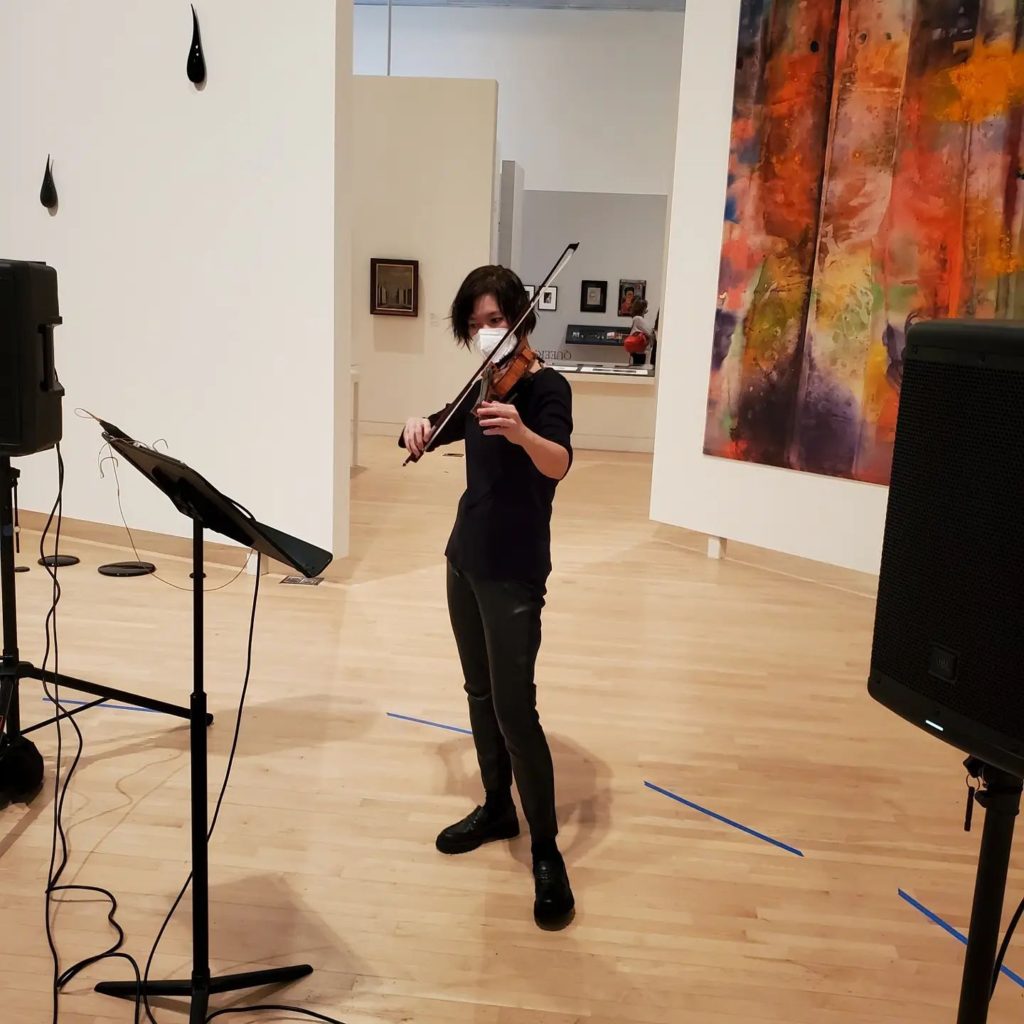
It was great to be back at Brandeis this week working with Eric Chasalow. Our project has two parts or versions, taking the same kernel of music in very different directions. In October, I came to Brandeis to workshop and talk to students about a few passages of a concerto for violin and chamber orchestra that Eric had started. This Wednesday, we were at the Rose Art Museum for a few hours, where I improvised from a page of material he’d derived from the concerto, while he used various kinds of electronic processing, exploring what happens with a violin interacting with the museum space and the visitors. The Rose has been the site of new works by Alvin Lucier, John Cage, and Christian Wolff. Thanks to the music department for recording the visit and to the museum for having us activate the space again.
 .
Shortly before this visit, Eric said he wanted to make a demo recording of the finished three-movement concerto, with piano. So I quickly learned the piece and on Thursday morning recorded it with Yoko Hagino playing the also challenging piano reduction. On no rehearsal aside from a play through the piece, we plunged in and made the recording. I was very glad to play and hear it and get it off the page. Great piece and energy, beautiful harmonies, and I think people will enjoy it. It will be premiered with orchestra with BMOP and Gil Rose.
.

thoughts

.
(2018) I think art can be whatever you feel it to be, whether having a deep social purpose or as light entertainment, or for pushing challenging frontiers and communing with a certain group. Anyway some of my favorite artists often work(ed) between categories.. between more direct expression and more “experimental” or abstract or unusual things that satisfied their own needs and were appreciated by particular people. I think Beethoven did that, also Stravinsky, for instance. Over the years. And they figured out how to bridge these things sometimes, so the popular stuff was still so ingenious and full of sophistication and surprise on some level, and depth rather than clichés.
 .

recital at PS21 Chatham

Pavilion Theater PS21 Landscape and Theater

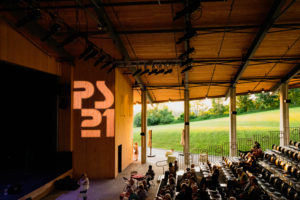
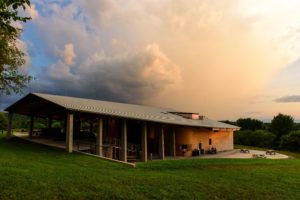
This August I was very excited to give a live recital at the marvelous semi-outdoor theater at Performance Spaces 21 in Chatham, NY. PS21 put together of series of solo concerts and I was delighted to be on the line-up.  I played the Bach A minor solo Sonata and “modern classics” by Elliott Carter, Pierre Boulez, and Mario Davidovsky. The video of the livestream is also viewable here. A great review

About interdisciplinary collaboration

808352_1

Thanks to the Violin Channel for asking me to write about interdisciplinary arts and my lifelong interest in them! Text below:

In first grade, my class was asked to make human figures from colored paper to illustrate what we wanted to do when we grew up.

Enthusiastically, I made three figures and called them a violinist, a writer, and a poet.

I remember drawing and cutting out the figures and outfitting them with clothes and violin and bow, paper and pens.

I had recently begun playing violin and had just written my first short story.

I grew up in a house filled with music and my own life has been centered around music since my pre-teens.

Music is the most mysterious of the arts, sound being invisible yet highly physical, its emotional impact obvious yet its meaning hugely subjective.

Music is made of materials and tools – sounds, rhythms, time, silence, volume – which together communicate and move us in ways we can never totally define.

Since childhood, I’ve kept up writing of various sorts and always been immersed in all the arts, taking in performances, movies, books, visual art, and learning about the artists.

In recent years, I’ve had opportunities to collaborate with a number of wonderful choreographers/dancers, poets/speakers, and visual artists. In my experiences collaborating with, or creating in, different genres, I’ve found it thrilling to combine the bodily senses and steer the imagination to less familiar pathways.

I think what has most intrigued me and affected my work is how blended the art forms actually are.

When we think of putting art forms together, we of course think of opera, or dancing to music, or film with music.

Or we think of musical compositions specifically inspired by another artwork, say a painting or poem.

Besides the ways in which the genres can enhance or inspire each other, I’ve been fascinated exploring the aspects they share.

For instance, playing music involves physical qualities of dance: in the movements we make in response to the music, in playing our instruments and in performing or communicating with others.

Dance is related to acting, in the embodiment of motivations, desires, the gamut of emotions.

Both acting and dance involve a musical kind of phrasing, of timing and inflections.

In music, a performer takes on roles like an actor: I often think of the composer as the playwright whose personality permeates the work, and the composition as the various characters, and maybe narrative, in the play.

Musical composition also can be analogous to ideas in visual art: the use of space/time, repetition, perspective, and so on.

When I study a piece of composed music, I sometimes visualize it as a painting or sculpture, and when I write about music, I go back and forth between the verbal and musical, grappling with the specificities and ambiguities in either genre.

When I’m playing music, sometimes I think of myself an actor or dancer to connect more deeply with the humanity expressed in the sounds.


Heritage and Harmony: Asian musicians

Thanks to WQXR and Donna Weng Friedman for the wonderful project “Heritage and Harmony” and for including me in this celebration of Asian and Asian-American musicians. They asked me to choose a short work by an Asian composer and make a video of it, with a spoken intro about my background. I played “Dramatis Personae” (2016) by Anthony Cheung and talked about my Taiwanese mom and her path in “classical” music. Anthony made a video talking about his piece and the complex influence of his heritage on his work.


AMOC in Cultured magazine

amoc2


AMOC
is in the new issue of Cultured magazine. Beautiful article and photos by Emma McCormick-Goodhart and words from several AMOC artists.

Among many things we look forward to is the 2022 Ojai Festival, for which we are collectively the artistic director.

I am also very excited to be working with AMOC on a new production of Luigi Nono’s “La lontantanza nostalgia utopia futura”, with Zack Winokur and my longtime collaborator Christopher Burns. It’s wonderful to have this opportunity to thoroughly rethink and reinterpret the piece both musically and as theater.

. amoc3 

Mario Davidovsky (1934-2019)

Mario Davidovsky passed away on August 23rd. I was invited to write this reminiscence for New Music Box. Text also below.

[A passionate artist and person, and a fantastic composer, Mario was an imperfect but deeply committed citizen of the world, and a friend and mentor to me. I loved him, though I also have my own integrity and mind, and many influences and personal associations. I appreciated the love and support he doled out to me and many people. Some of his compositions, such as the Synchronisms, are well-known classics of 20th to 21st-century concert music.]

IMG-20141019-WA0010 (1)

12190947_10153325820248823_5583978052737845007_n

I was reading various posts online and absorbing the news that Mario Davidovsky had died, when I received an email asking if I’d like to write a personal reminiscence for NewMusicBox. I was moved and said yes. As I thought about it in the days following, I felt I had pretty much summed up my thoughts on Mario’s music and values in an essay I wrote for celebrations of his 80th birthday. But I appreciate the chance to think more on his personality and my relationship with him, and to add to the wonderful flood of reminiscences, photos and stories about him.

Composing modernist music is an esoteric activity within the general culture, but Mario made substantial connections with a great number of people. He was a passionately involved member of society and the music world. A lot of people have noted his generosity nurturing other artists, his integrity, his vehemently stated opinions, his volubility and notoriously long conversations that would range over world history, science, religion, politics.

In recent years I would call Mario for no particular reason, just to check in and chat. We talked about music and musicians, of course, but also Silicon Valley, environmental problems, branches of religious philosophy, the big cultural institutions, changing sources of funding. Mario played violin in his youth and that was certainly part of my rapport with him. Another commonality was the Jewish diaspora: both his family and mine (my grandfather) left Europe due to persecution and immigrated to countries in the southern hemisphere (Argentina and Australia respectively). He was always eager to hear about my “peripecias” after I’d been traveling and we’d compare Spain’s characteristics with South America, or the variety of Asian cultures, or one American city’s scene with another. He’d been to many of these places.

By the time I really got to know Mario, he was mainly devoting his time to taking care of his wife Elaine, an elegant former dancer who was ailing for some years and passed away in 2017. He would say, “I hardly go out anymore, I’m at home always” and it was without question where he wanted to be, by Elaine’s side. But he’d also say “Tell me what’s happening! What do you see out there? Have you heard anything good?”  I would tell him about interesting concerts going on, and what pieces and programs I was playing. Often he would say “Oh yes, So-and-so was at the Conference in the 1990s” or some other decade, and proceed to describe their music then and whatever he had heard of theirs since, and any news or tidbits of rumors he’d heard about their doings.

He was often warm in his assessment of composers but occasionally he’d say, “Ay, but the music is sheeeet!” About music I was playing that he wasn’t familiar with, he’d ask “What’s it like?” I loved his challenge to express not just its basic characteristics or the inspiration behind it, but to describe from my observation what was happening in the music itself, how its elements seemed to relate.

I first met Mario in 2004 through composer Matthew Greenbaum, who had studied with and known Mario a long time. He invited violist Stephanie Griffin to perform the Davidovsky String Trio on a concert in New York and she asked me to play. I was enthralled with his music from the start. (Stephanie’s group, the Momenta Quartet, was formed from this and I played with the quartet in its first few years. They will perform the String Trio again on October 15 at the Americas Society).

I was very excited about Mario’s pieces and I soon explored and performed more: the Duo Capriccioso, Synchronisms No. 9, three of the four Quartettos, Romancero, the Biblical Songs, Chacona. I got to play all of these for him. As I said in that essay, Mario took many ideas he gleaned from his work with electronics and used them in his acoustic chamber music. In rehearsal he talked about the startling effects of simultaneities and blended sonorities, the singing passages. He emphasized abrupt shifts, saying the effect of switching from non-vibrato to vibrato should be sudden “like you pushed a button,” urging to press down very close to the bridge for noisy attacks marked “coarse!”, then asking for playing at the limits of extreme quiet. Contrasts were not only about dynamics but timbral qualities, from hits and snaps that were hard as stone to gentle, held tones of soft velvet.

For someone known for his work with technology, Mario’s musicality was also remarkably linked to older styles of playing. In modern music, glissandos are often played gradually and evenly to draw out the sliding effect, but Mario repeatedly said that his glissandos were a “real portamento,” that is, a quick slide coming at the end of the note, in the style of Fritz Kreisler or Mischa Elman. In a number of Mario’s pieces, such as Duo Capriccioso and the Quartettos, there are spurts of fast spiccato passages or arpeggiated ricochet bowings, and he’d say they should be tossed off “like in Wieniawski, Sarasate.” Sometimes as Mario listened to his music, he would sway his upper body and make expressive gesticulations, as if he were playing along. It makes me think about my former teacher, violinist Felix Galimir, who was often described as playing with such imagination, understanding, and emotion it felt like he was composing the music himself. To me, Mario composed like he was playing the music himself—the character of his music came so much from the physicality of playing the instruments, even (or especially) when striving for dramatic effects inspired by electronic music.

Mario’s cultural roots were the core of his being, as was his own family. He was immersed in the music community, ready to wade into the thick of things, but if his family needed attention, he would drop everything to be with them. After Elaine passed, he said he was very lonely. There were people calling him, coming by to visit, and he was very appreciative. But he felt sad and alone without his dearest companion and I think was also, in his philosophical Jewish way, dealing with his existential sense of being a solitary soul in the world.

Once when I wrote him something sympathetic, he replied “I never suspected that loneliness could be so overwhelmingly infinite….God must be the utmost lonely thing in the universe—he only has himself…. At least, I have Zabars and can get some cheese and bagels!!!!”  It was a joking nudge because we sometimes ran into each other shopping at Zabar’s (indeed often in the cheese section).

I will miss his vast and loving support, his calling me “Querida Miranda” and saying “Heyyyyy!” when he recognized my voice on the phone. I hear the sounds and piquant cadence of his voice all the time now, just as I hear his fierce and tender humanity in his music.

Interview in April Magazine


Thank you to April Magazine and Jill Marshall for interviewing me for
 this article about “embracing the world with violin and viola”.

I’m happy with how the article turned out but thought it would be nice to also share some “outtakes” from our (Oct 23, 2016) email interview:

— Do you prefer playing solo or as part of an ensemble?

I love to play both solo and with others. I would not want to do just one or the other. Violinists are lucky to have some great solo repertoire but it’s been very interesting to me to further develop what the instrument can do and encompass expressively on its own. The thing about playing solo is that you are the one who has to deliver and speak for yourself. You have to do it, no one else can do it for you. I like that situation of responsibility and having to focus on what you want to say and how you can do that. On the other hand, I enjoy the dialogue of playing with other musicians, the reacting to each other, the spur-of-the-moment interplay as well as drawn-out discussions about the work we are doing together. 

I feel it’s just as in life – it’s not even a metaphor, it’s the same thing. You need to be alone sometimes, to learn how to both support and critique yourself, how to express yourself and not rely on others. How to listen and think for yourself, not just accept what others around you are saying. On the other hand, you need to be feel part of the group and to understand your role in a larger context. How to have a discussion, how to embrace differences, how to cooperate in an agreed-upon structure. Interacting with a small group, a crowd, or with one other person – it all teaches you a lot about yourself. It’s also just fun and enjoyable.

— Was the violin a natural choice for you ? Did (do) you play other instruments ?

My first violin was a hand-me-down from my older, Taiwanese-American cousins. So I didn’t actually request a violin but I did take to it very quickly. I always wanted to play my violin as soon as I was home from school. I also play a bit of piano.

— Do you remember your very first performance in front of a discerning audience ?

The first performance I remember was at the Hoff-Barthelson music school when I was five or so. I was sick with the flu and my parents said I’d have to miss the concert. But I was so disappointed so they let me play, and I remember being onstage and feeling all hot and feverish but so glad to be playing. The first performance I gave for a discerning audience was probably my audition at Juilliard when I was eight years old. I played a Telemann concerto and the Valse Sentimentale of Tchaikovsky. The teachers were smiling at me when I finished, and I remember my future teacher Dorothy DeLay said to me, “Beautiful music, isn’t it?”

— You travel a great deal. Do you get down-time to explore the towns and cities where you perform ?

I love to travel – not so much the transportation part but visiting new places. Sometimes there isn’t much time – there are rehearsals and concerts and then you have to leave right away afterward – so all you may get to see are the hotel and the hall, and maybe a few other places such as a school or a radio station studio, and the ride to/from the airport! But I love if extra time can be squeezed into a schedule. It’s amazing what you can see in one day. I love to walk around, to see important historical sites but also just to get the feel of the neighborhoods where people live and work. And to go to concerts in other places, to hear the local musicians.

— You’re an Australian-born American with Taiwanese/Austrian/English heritage. Have mixed heritage and vast travel experience brought anything specific to the way you approach creativity and accessibility when making/performing music?

Having a very mixed background has affected my perspective in many fundamental ways, and certainly as an artist. I think it’s given me a basic belief that communication and connection are always possible between different cultures and peoples. It has given me a continual interest in trying to understand where others are coming from and what are the particulars of that culture that they have in themselves. And I think that attitude has carried over into what I do as an interpreter/performer of music: with each piece, I endeavor, as an actor does, to understand the psyche of the composer, wherever he/she may come from and whatever musical language they are using.

Western classical music came from Europe – much of it from Vienna where my grandfather was from – and then spread as an art form to America and other countries of the world. We tend to think of European giants like Mozart and Beethoven as defining “classical music” but classical music has, in the best American spirit of inclusion, now come to involve artistic voices from all over the globe, from every country and ethnicity. I really like to program music by composers from various countries and discuss how their heritage or their world outlook has affected their music – sometimes that’s in an overtly folkloric way, sometimes it’s more subtle or abstract.

Many of us experiment with and partake of different cultures, and wonderful hybrids happen, but I think there will always be a tension between this hybridization and the preservation of cultural identities. That’s causing conflicts but it’s also a huge opportunity to adopt an outlook of respect and try to understand each other, to value those differences and specifics that make each group part of a strong whole. Artists are often in the vanguard of that kind of understanding and exchange, because we essentially deal with personal and universal experience, and communicating that with others.

— When you’re not working through a calendar of events, what kinds of things do you enjoy doing?

I love to take walks and do yoga. I really enjoy an interesting conversation with a friend over a meal or a cup of tea. I love to go to concerts. I have a passion for all art forms. Looking at visual art or a dance piece and understanding what those artists are doing is a great pleasure to me. I can’t draw but I’m always reading something, novels, stories, essays and articles online. I like to look around for contemporary poetry that appeals to me. I enjoy cuddling my cat Oski.

Hersch violin and piano music

hersch1

.
I have performed eleven works by Michael Hersch so far. He has a grippingly expressive musical language and poignant sense of harmony. The solo violin piece titled “the weather and landscape are on our side” – written for me – conveys hefty emotional substance through particularly delicate and subtle means. There are a few loud outbursts, but it is mostly very eerie and sometimes whispers on the edge of silence. In this piece, he used certain non-pitched string techniques for the first time and, also for the first time, has the violinist briefly sing while playing, rather similarly to the Luigi Nono piece I play, La lontananza nostalgica utopica futura. Michael’s piece also involves playing extremely high pitches and close intervals, very quietly.

His piano music stems from his remarkable and idiosyncratic ability as a pianist. Michael performs infrequently, but his playing is displayed on the documentary film “The Sudden Pianist”. His piano writing exploits the inherently massive power of the instrument and makes innovative use of the pedals, along with a wide variety of articulations. The built-in time/space (silences and phrase lengths) in his music allows for chords to shoot into the air and literally hang there vibrating for long seconds, so that we listen as the pitches within harmonies move around kaleidoscopically and slowly dissolve at various rates. The dimensions of the instrument’s sound-producing capacity and the variety he draws from within that sound suit his wish to write large-scale works that take advantage of its extremes.

He has also written a great deal of solo and chamber music for strings. These pieces often feature frenzied chordal and double-stop playing, use of the bright open strings, and tumultuous fast movements like in his piano works. There is a particular emphasis on harmony, on sustained chorale-like polyphony and the throbbing vibration of notes against each other. He stipulates a sound that is non-vibrato or using vibrato sparingly. In quiet music, subtly adjusted degrees of pressure or lightness can be used to produce varied gradations of dynamics below the basic piano/pianissimo threshold. With this approach, the player can dissipate the core of the tone so that it tends toward the fragile and intimate. There is only so long a resonance or loud an attack that any stringed instrument will produce, but the variety and range of nuances of bow friction can be infinite.

hersch5  hersch3

starting an ensemble

When I was finishing my grad degrees, I got involved in the burgeoning, diverse new music scene in NY and I was a founding member of several ensembles that are now in their second decade. I performed in these groups frequently and in some cases also worked administratively. I’m currently a member of one group, counter)induction, which is in its 15th year and consists of 5 instrumentalists and three composers. The musical and administrative experience I gained from these groups helped me as the founder and director of my own music organization, Nunc. I started Nunc as an informal concert series, eventually incorporated it as a non-profit, and I curate and produce programs on a project-to-project basis.

I’m sometimes asked by young people for practical advice for this kind of endeavor.

To find players, you need to get to know people who share your musical interests and goals. At your school, you should get to know the musicians there who are eager to play new works. Ask among your friends if they’ve met players at festivals or other schools they attended. Sometimes it’s great to have experienced players who are already very involved in the music but sometimes it’s an advantage to find young people who are starting and not too busy yet and will really invest their energy into it with you.

As you start to generate an audience and some notice, musicians will probably be excited to keep going and help it grow. Put on the best concert you possibly can when you start. Excellence prevails.

For grants, you should look at New Music USA, the Foundation Center, Grantsmanship Center.. A lot of info is online. You should research the government grants by state, city, borough. You’ll probably need to incorporate as a non-profit, so you should consult a fiscal sponsor program like Fractured Atlas or The Field and look up the non-profit guidelines for your location. I used Volunteer Lawyers for the Arts in order to find an inexpensive lawyer.

Regarding concert venues, you have to ask around, visit to look at places, ask their rates, maybe work out deals with them. To do what you want to do, you may want to find organizations already presenting some kind of arts or music in those neighborhoods, or schools that would love a visit from you, and partner with them.

Hope that’s helpful. Research online and start trying to make things happen and you will hit the ground running when you graduate.

Liner notes for Melting the Darkness

“Melting the Darkness”

Notes by MC (Nov. 6, 2013)

This album ventures into regions of the art of violin-playing the significance of which is now becoming clear. Devoted entirely to microtonal compositions for violin and pieces for violin with electronics, this CD presents works of seven composers who have been challenged by these areas of discovery to create intriguingly fresh and surprising sound worlds.

Like opera singing and ballet dancing, the violin-playing tradition as situated within the Western classical heritage is a tremendously rich vein of history and achievement. It has involved a collective cultivation of craft and technique, an establishing of certain models of sound, and particular styles of virtuosity and performance that have been passed down through a couple centuries. I grew up, like many burgeoning violinists, steeped in this tradition, attending concerts by Nathan Milstein and Isaac Stern, studying with Dorothy DeLay and Robert Mann, listening to recordings by Kreisler, Elman, Oistrakh, Hubermann and more. These influences remain central to my musical identity on some level, as does the largely tonal, Baroque-to-Romantic repertoire that this violin-playing tradition addresses. I also cherish my many formative experiences playing chamber music, often with piano or other string players.

Since turning much attention in recent years to the music being written in my own time, I have found fascinating certain areas of experimentation that have taken my instrument beyond the familiar glories of its heritage. One of these is the use of microtonality- a system of intervals involving distances smaller than the half-step (the keys on a piano). I have been intrigued by both the physical aspects of working with such intervals, and the idiosyncratic ways in which composers use such intervals for their own expressive aims. Another interest has been noise- that is, non-pitched sounds, often percussive or abrasive, produced by unusual techniques on the instrument. A third area I’ve been eager to learn more about has been music involving electronics. Since electronic music’s beginnings, using spliced reel-to-reel tapes decades ago, the possibilities of the technology have exploded so that there are numerous ways in which to create or generate sounds and to interact, as a live performer, with them. This has led to a palette of sound possibilities and a degree of agility of response often not offered by traditional instruments.

Except for Iannis Xenakis, who died in 2001, the composers on this album are all artists with whom I’ve had wonderful collaborative friendships. We have worked together and they heard me perform these pieces live. The works by Burns, Sigman and Rowe were composed for me, and I was involved at certain stages of the pieces’ progress. While most of the works are essentially “dark”, having an overall atmosphere of anxiety, danger or sadness, each piece also has elements that affirm a sense of warmth, hope or clarity. The pieces on the CD are ordered in a way that I feel illuminates the interplay between dark and light in these pieces, and also the different ways in which the composers used the resources of microtonality, noise and electronics.

Iannis Xenakis (1922-2001), a Greek/French citizen, was not only a musician, but an engineer, architect, mathematician and author of major theoretical works on music. In his compositions, he incorporated ideas stemming from his scientific interests, pioneering electronic music, and applying stochastic and aleatoric processes, and set and game theory. While his works derive from highly cerebral concepts and treat sounds as objects put through experimental processes, the results are often surprisingly visceral and emotional. Tension and excitement build up as layers accumulate and clash, and the combination of control and disorder in the rhythm creates a wild sense of motion. Xenakis wrote “Mikka S” in 1976 following his first solo violin work, “Mikka” of 1971. Both pieces are based mainly on the glissando, a sliding pitch effect. Whereas “Mikka” consists of a single line, “Mikka S” ups the ante with two contrapuntal lines that move independently. At times, this requires extreme physical flexibility, as the violinist’s fingers must converge and cross directions, or stretch large distances and across strings. The two lines of music are in almost constant motion and frequently create a buzzing microtonal friction, but they coincide now and then on momentarily consonant intervals. Toward the end of the piece, the energy of the constant sliding erupts into boisterous bowed attacks and jagged, short glissandos.

Oscar Bianchi’s Semplice is a sparkling, virtuosic work in which fleet lightness subtly shades into something more anxious and spiky. Written in a relatively conventional violinistic style, with spiccato flourishes and flights to the upper registers, the piece’s short phrases take on a somewhat more aggressive cast in its middle section, in which microtonal intervals pervade the music and the scratchy noise of ponticello adds an edge of prickliness. Bianchi’s note:

Partly as reaction towards an overwhelming practice in our times of associating all sorts of notions of complexity with musical representation, I gave to this solo violin work the title of Semplice. This is the Italian word for “simple” or “natural”. Despite being based, as one hears rather quickly, on clearly non-simple musical material, this work aims towards an ideal of an organically simple way of playing. In a similar fashion, Gaudi found in nature an expression of simplicity made by highly articulated forms and complex phenomena. I wished to propose in Semplice a music in which gestures are constituted of subtle quarter-tonal inflections as well as minute, timbral definitions, compressed into quick, almost verbal (vocal) brilliance.

Georg Friedrich Haas has probingly ventured into the sonic, harmonic, and expressive possibilities of microtonality. His work uses minute intervals like eighth-, sixth-, and quarter-tones, and pitch relationships from the overtone series, causing intense beating of frequencies and “difference tones” that buzz along. In addition to generating a radical focus on sound itself, Haas’ insistence on microtonality has created new wells of expressive meaning in these relatively unfamiliar sonic distances. Resonating with the malaise and despair of much twentieth-century art, his music finds nuances of despondency and pain, but also surprising beauty, in the uncomfortable spaces between tones. Haas has revealed that, while composing de terrae fine (2001) on a sabbatical in Ireland, he was mired in a severe depression. The title, meaning “from the end of the world”, evokes not just an apocalyptic vision but a devastating sense of isolation. The music’s single line of winding microtonal motions seems to trace the twinges in a person’s lonely, anguished train of thought. Long tones swell in heaving sighs. At times, the overwhelming feeling of desperation gives way to a sickly nostalgia, with startlingly sweet double-stops and sliding arpeggios. About halfway through the work, the mood turns to anger, as pounding chords burst out. Moving upward by microtonal increments, the chords build in accelerating waves to a violent frenzy of raging despair- followed by a collapse into exhaustion, as a few wisps disappear into silence.

Christopher Burns composed Come Ricordi Come Sogni Come Echi after we had been working together on Luigi Nono’s La Lontananza Nostalgica Utopica Futura, an hour-long duo for violin and electronics. In Nono’s piece, the violin is a vulnerable, human protagonist amidst the ominous environment of recorded sounds. In Burns’ homage, this protagonist is taken out of the threatening context, and attention is focused on the intimate details of the violin sound, the grainy friction noise, and the warmth of the human voice, which, as in the Nono, joins in polyphony with the violin pitches. In the fourth and fifth movements, microtonal counterpoint creates a delicate tension. Burns writes:

I’ve been performing Luigi Nono’s La Lontananza Nostalgica Utopica Futura since 2002. Nono’s composition is one of my most cherished musical experiences as a listener, and my continuing work with the electronics part has been profoundly influential on my development as a musician. Composed in 2011, Come Ricordi Come Sogni Come Echi is a series of six studies exploring a few of the most intriguing elements from the violin part of Nono’s work, and seeking points of connection between La Lontananza and my own compositional idiom. The title (which translates from the Italian as “like memories like dreams like echoes”) is a performance instruction in Nono’s score, and reflects the ways in which Nono’s materials and ideas resonate through my homage. The piece is dedicated to Miranda Cuckson, whose thoughtful collaboration, detailed musicianship, and inventive approach to the performance of the Nono inspired the creation of these etudes.

Alex Sigman’s VURTRUVURT for violin and live electronics was commissioned for this recording. In this piece, the violin is a live denizen of an urban sound world, adding its startling noises to a world of machines. The electronics part is triggered and adjusted by an additional live performer. The piece was recorded in studio, after which the composer added some further sound processing and also created the spatialized imagining found on the 5.1 surround disk. Sigman writes:

V is for Vehicle and Volume, not Violin. U is for Union. R is for Resonance, Recording, Reflection...and T is for Trigger. VURT refers to the 1993 cyberpunk science fiction novel by Jeff Noon. Set in a dystopian Manchester, the novel chronicles the (mis)adventures of a gang of Stash Riders, who travel between Manchester and a parallel universe called Vurt. The boundary between the universes remains permeable, as Vurt creatures and events materialize on Earth. The sound sources employed in VURTRUVURT include elements evocative of the decaying urban and industrial environments described by Noon, as well as songs by Manchester bands of the 1980s-90s that were influential upon the his writing. These sources were also central to generating the violin material. In performance, the electronics are projected through a pair of small sound exciters: one attached to the violin, the other to a resonating glass surface.  The violin thus becomes an electrified tension field, a physical point of actual/virtual intersection and cross-influence.

Ileana Perez-Velasquez’s work “un ser con unas alas enormes” is for violin and fixed media: the electronics were previously recorded onto a CD as one single track, with which the violinist performs in real time. The piece evokes a lush natural world with dangerous-sounding animal calls and insect noises in the electronics. Cuban motifs and a full-throated, heated lyricism characterize the violin part. Perez-Velasquez’s note:

“un ser con unas alas enormes”, which translates as “a being with enormous wings”, was inspired by the 17th Freeman Etude for violin by John Cage. Within the hectic gestures that are a major part of this etude are passages reminiscent of Cuban rhythms. An important idea for Cage is that human beings can be better themselves by overcoming their limitations. This piece translates that spirit; humans improve through the use of their imagination. The title is also related to the literary work by Gabriel Garcia Marquez, “un hombre muy viejo con unas alas muy grandes”. The tape part, as my departure of style, is fragmentary, and contains processed excerpts from the Freeman Etude. The piece also includes concepts of silence that are present in non-Western music. The use of silence as a conscious part of the piece yet again reflects back to Cage.

For Robert Rowe’s piece, Melting the Darkness, the violin part was written and recorded first; the composer then created the electronics as an accompaniment to the violin part, using processed snippets of the violin-playing, samples of percussion instruments such as the tabla, and other synthesized sounds. The violin propels the narrative of the piece, with a warm, largely conventional style of violin-playing.  Rowe writes:

Melting the Darkness was written for Miranda Cuckson and commissioned by the New Spectrum Foundation. The piece is built around contrasting styles of music and performance, ranging from gritty, rhythmic phrases to more lyrical and slowly shifting sonorities. These contrasts are amplified and elaborated by an electronic commentary consisting of fragmented and processed material from the violin performance as well as a number of secondary sources. The title comes from The Tempest (as it should when a piece is composed for Miranda): “…as the morning steals upon the night, Melting the darkness…”

thoughts on music at the new year

 I woke up this morning with these thoughts in my head so I wrote them down:

Here’s to
– music as a lifelong endeavor and part of personal growth
– the passion of music
– the flow of music in time
– the mathematics and science of music
– music’s ability to express anything
– the physicality of playing music
– the physicality of the dance in music
– the disembodied selflessness of feeling in the moment that you are only in service of the music, of wanting that phrase or sound to express what it wants to express, of making the music “happy”
– the communality and liveliness of a concert and putting on a show
– the ephemerality and unpredictability of the live moment in music
– the many hours of preparation and work before a performance
– the sculpting of sound and music in the recording studio
– the complexity of recording and making recordings, the spontaneous and the mulled over, the purity of focus and the act of documenting people, the making of a thing like a book or film or painting
– beautiful tones
– breathing and furniture creaking
– listening to lots of music
– sometimes not listening to music
– talking and writing about music
– not talking and writing about music
– thinking about anything
– the ambience of a casual concert
– the ambience of a formal concert
– meeting with and talking with people at and after concerts
– being alone with your thoughts after playing or hearing a concert
– entertaining while enjoying and responding to an audience’s responses, facial expressions, applause
– becoming unaware of anything at all but your innermost, nonverbal feelings while playing, the deepest emotions tapped into by the music
– discovering unfamiliar music
– playing pieces you know many times
– wanting to give people a terrific and fun experience for those couple of hours
– an easy phrase or flourish
– sharing music as a communally cathartic, non-escapist confronting of serious reality
– stretching your being by pushing your art forward while feeling the emotional ties to the past
– traveling a lot and being thankful for the ability to travel, which makes it possible to see different places, and mainly, to be with people
– enjoying the familiarity of home and treading the well-worn sidewalks of one of the world’s great cities
– recognizing life’s many facets and paradoxes
– when dealing with the murk of misunderstanding, working with others to reach the happiness of clarity, strength and integrity
– love of musicians

[This was originally a Facebook post in 2014 but it somehow disappeared. Thanks to John Darnielle, great musician and writer, who reposted it back then on his Tumblr.]

Ralph Shapey, Beethoven, and Dotted Rhythms

Ralph Shapey, Beethoven, and Dotted Rhythms: a Violinist’s Point of View

by Miranda Cuckson 

            For the violinist, Ralph Shapey’s compositional output offers an abundance of challenges and strikingly expressive music. Shapey wrote for the violin throughout his life, producing a large catalogue of works for the instrument. These include eight solo pieces, most of them multi-movement; seven pieces for violin and piano; six works for violin with orchestra or ensemble, including the Invocation-Concerto (1959) and a concerto entitled The Legends (1999); and duos with viola, cello, and voice. He also wrote numerous chamber works involving the violin, including ten string quartets, several trios, and many ensemble pieces.

When I planned my first album of Shapey’s violin music,1 I was just beginning to explore his work. I chose to record five pieces spanning his compositional career: Etchings for solo violin (1945), Five for violin and piano (1960), Partita for solo violin (1965), Mann Soli for solo violin (1985), and Millenium Designs for violin and piano (2000). In working on these pieces, I found that getting to know his music from a violinist’s standpoint is extremely interesting. In addition to the expressive satisfaction the pieces afford, they reveal a great deal about his compositional preoccupations and evolution, while also evincing his substantial background as a violinist.

During the early part of his musical life, Shapey was very active as a performing violinist. He began to play the instrument at age seven, and soon displayed much natural ability. In his teens, he studied with Emmanuel Zetlin, a former assistant to the pedagogue Carl Flesch. In the  summer of 1945, he took lessons with Louis Persinger, the teacher of Yehudi Menuhin and Isaac Stern. Shapey learned much of the standard solo repertoire, including such pieces as the Beethoven and Sibelius concertos, the Bach Partitas and Sonatas, and the Wieniawski etudes. He went on to freelance as a performer, working with artists including Adolf Busch and the Juilliard Quartet. Violinist Robert Mann was a close friend of Shapey, and describes him as “a decent performer with a fluent command of the instrument.”[i] In the early 1950s, Shapey stopped playing, deciding that his composing and conducting projects left him too little time to practice. He taught violin for a time, in addition to composition and theory, at the Third Street Settlement School in New York.

In writing his own violin music, Shapey remained devoted to the instrument’s traditional qualities, while audaciously pushing the limits of conventional violin-playing technique. Unlike composers such as George Crumb, Luigi Nono, Krysztof Penderecki, and Luciano Berio, who investigated “extended” techniques involving non-pitched noise, percussive strokes, and microtonality, Shapey innovated by expanding upon the fundamental attributes of traditional violin playing – in particular, the capacity for lyrical melody, and for polyphonic, chordal textures. His pieces demand the familiar violinistic essentials – resonant tone, pure intonation, clear articulation – but feature linear shapes and chords requiring extraordinarily large left-hand stretches, unorthodox fingerings, quick leaps around the fingerboard, and adept string changes in both staccato and legato contexts. Shapey’s approach to writing for the violin recalls Leonard Meyer’s well-known description of him as a “radical traditionalist.” Shapey emulated the structures and motivic ideas of Beethoven, Brahms, and Haydn, while breaking away from tradition in his gestural and harmonic language. Similarly, he drew upon the techniques of traditional violin-playing, opening up new expressive possibilities of the player to extremes.

Shapey’s violin works are especially fascinating because of this intersection of his musical and communicative aims with his physical approach to the instrument. Though the technical puzzles he poses for the player are absorbing in themselves, those challenges are intrinsic to his expressive intentions. The huge intervals, leaps, and chords all contribute to what is probably the most pervasive characteristic of his music: its quality of expansiveness. Shapey wrote music with big dimensions – hefty, contrasting sections, dramatically wide-ranging melodies, and ruggedly distinct contours. At the same time, he exploited the physical characteristics of violin technique, with wide left-hand distances to be covered, and sometimes complex string crossings, in order to convey an expansive sense of space and time.

In all of the five works that I recorded, I observed a particular musical kernel that intriguingly relates to many of Shapey’s preoccupations, both expressive and technical: the dotted rhythm. This simple motive is featured prominently in all of these pieces, and indeed in much of Shapey’s oeuvre, with such frequency that it seems to have been something of an obsession for him. This makes sense when one notes that Shapey idolized Beethoven, and spoke often of Beethoven’s Grosse Fuge, Opus 133. The Grosse Fuge was performed by the Juilliard String Quartet at Shapey’s memorial service.[ii]

The Grosse Fuge, of course, presents remarkable ongoing strings of insistent, dotted rhythms. As Robert Carl relates, Shapey liked to tell people that he had spent a year studying Beethoven’s music, and that of Haydn, Mozart, and Brahms, in order to determine for himself the source of the strength of their compositions. He decided that this lies in the distinctiveness of their musical material, the almost tangible quality of their motives. Inspired by their example, Shapey described such concrete, compact musical ideas as “graven images,”[iii] or as musical “objects in space.”[iv]

In the Grosse Fuge, Beethoven used the dotted figure as a self-contained musical “object,” a building block that is the defining rhythmic element of the music, one with which he constructed whole passages and sections of the piece. The dotted rhythm possesses inherent musical traits that make it a vivid and intriguing compositional element with which to work. Its strongly articulated main beat makes it a firmly grounded pulse (whether or not the next beat is articulated or not), and its rhythmic components (long note plus short note) form an immediately recognizable shape. In contrast to the more horizontal directionality and constant motion of equal-valued notes, the dotted rhythm has a vertically weighted feel, and, in moderate to fast tempos, a natural jauntiness that denotes energy and liveliness. The rhythmic position of its shorter note can, however, affect the character of the motive in a variety of ways, depending on how it is played. It can rebound from the impetus of the main note, and pull briskly towards the next beat, propelling the motive forward, or creating momentum in a passage of continuous dotted rhythms. If purposefully delayed, it gives the figure a resistant and stubborn, or majestic and massive, character. If combined with intervallic leaps, the dotted rhythm possesses an extra measure of drama, conveying the sense of distances being crossed in a spurt of energy. Such leaps are a striking characteristic of the Grosse Fuge (see Fig. 1, mm. 30-31, or mm. 38-42), again suggesting that Shapey took inspiration from Beethoven’s work and seized upon its elements for his own creative purposes
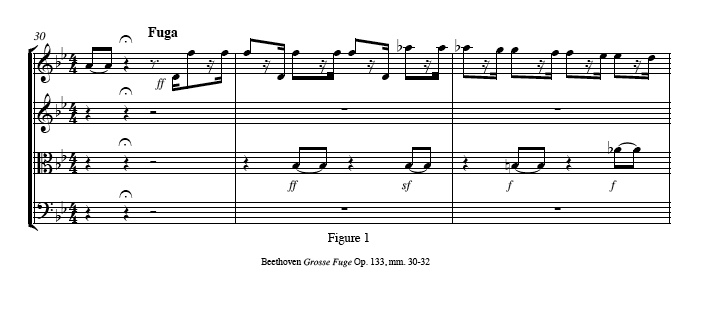
The dotted rhythm is prominent in the three faster movements of Shapey’s Etchings, an early solo work dedicated to Louis Persinger. The five short movements are variations of contrasting character. The piece is neoclassical in style, with frequently changing meters, and a spare monophonic texture that is sometimes enriched by double-stops. In this context, the dotted rhythm takes on an elegant, Classical, character. The “object” is tidily contained within the constraints of the meter’s pulse and its subdivisions. The rhythm appears frequently in the lively first movement, Moderato. It is first introduced in measure 3, incorporating a descending half-step motive introduced in mm. 1-2 (Fig. 2). 
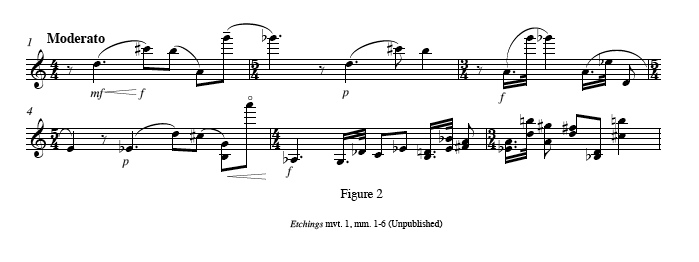
Shapey’s predilection for large leaps is already evident in the first bar’s wide-ranging intervals, the major seventh, D-C#, the major ninth, B-A, and the minor fourteenth, A-G. The expansive gestures of m.1 are restated in m. 3 in diminution, with the quick dotted rhythms enhancing the sense of acrobatic nimbleness.

The third movement, titled Moderato vigoroso marciata, is primarily in 4/4. It is composed entirely of homophonic double-stops. Its many dotted rhythms are self-evidently march-like. The fifth movement, Allegro très rhythmic, is faster, and features syncopations and more irregular rhythmic patterns (Fig. 3).
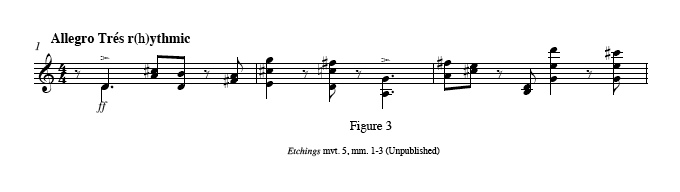
The rhythmic agitation of this movement causes the dotted rhythms to be more insistent in their forward motion. Their tendency to press onward to the next beat culminates in the triple stops in mm. 12-13 (Fig. 4). The last sixteenth note of m. 13 jumps into silence on the first downbeat of m. 14, toying with the expectations of the listener, as a syncopated beat arrives in place of the dotted rhythms of the previous measure.
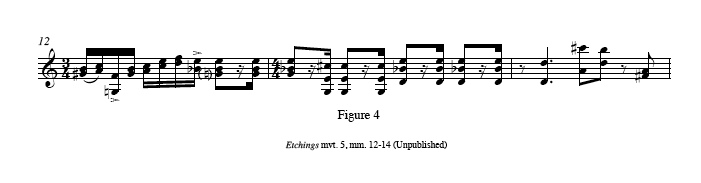
Overall, Etchings shows signs of Shapey’s interests in wide-ranging lines and chordal playing. However, aside from some large leaps, it does not pose the degree of technical challenge that he later explored. A hint of more complex technical problems occurs in m. 29 of the fourth movement, Andante cantabile, where a reversed dotted rhythm moves, legato, from a G to an F-A double-stopped tenth, a somewhat awkward move for the left hand to negotiate (Fig. 5). Perhaps Shapey reversed the rhythm to facilitate the movement of the hand. In any case, given the languid, lyrical mood of the passage, it seems musically appropriate to stretch the end of the beat, and ease into the double-stop. The high A emerges delicately and surprisingly as the G moves to the F underneath.
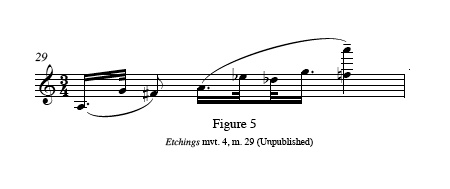
In Five, Shapey explored a rhythmic sense in which precise, firmly defined rhythmic ideas  exist within a meter-less context, engendering a tension between precision and freedom. In this five-movement piece, Shapey worked with the dotted rhythm, extracting its essential gesture, and transforming it into various guises. This technique is somewhat reminiscent of Beethoven’s handling of the dotted-rhythm motive in the Grosse Fuge. Beethoven turns the motive into related forms. He employs ternary groupings of quarter notes and eighth notes (Fig. 6), and sixteenth note patterns in which the last of four sixteenths is the same pitch as the first of the subsequent group, suggesting a dotted rhythm (Fig. 7).
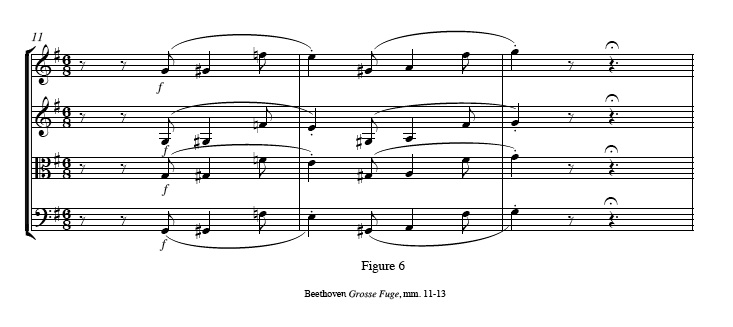
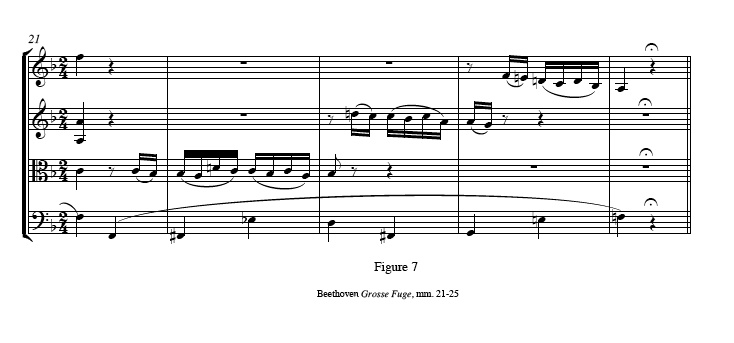
 

Rather than focus on the whole motive, Shapey concentrated on the upbeat gesture inherent in the dotted rhythm. In the opening Recitative movement of Five, the violin begins with a straightforward, broad dotted rhythm: a dotted quarter note plus an eighth note, in a tempo of quarter note=46. Shapey then presents several brief musical ideas in succession: a quick triplet, a single grace note, then an actual dotted rhythm. These all function as rapid upbeat gestures, each giving the effect of a dotted rhythm’s short note, leading into another event (Fig. 8).
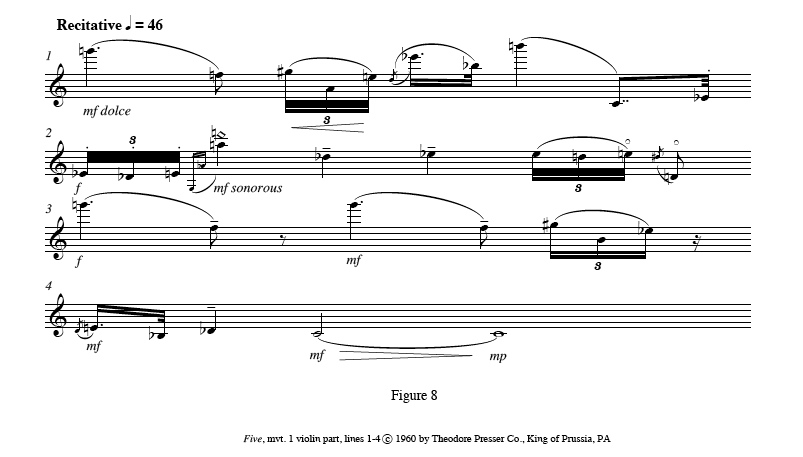
Wide intervals abound: the opening G drops a major ninth to F, and the quick Eb–Bb dotted rhythm leads to a high B, requiring a fast left-hand shift. This pitch is a third higher than the opening G, producing a dramatic line of high peaks. A descent to the violin’s lower register brings about another series of “upbeat” gestures: a double-dotted rhythm, a triplet, and a two-note grace-note figure. These gestures lead to an A harmonic, the highest pitch so far.

Shapey employs these triplet and grace-note upbeat figures throughout the movement. Because of the absence of both meter and a regular pulse, the dotted rhythm gesture generates  points of pronounced emphasis, and motion toward those points. The rhythm serves to create “objects” which exist in a free expanse of time. When strung together in a quick series, the gestures suggest both a repeated thrust toward a goal, and a certain awkwardness or struggle, comparable to climbing over a pile of rocks in order to reach a higher level.

In evoking the dotted rhythm idea, Shapey often clarified his intention by writing symbols indicating “upbeat” and “downbeat,” a notation that he used in line 9 of Five (Fig. 9).
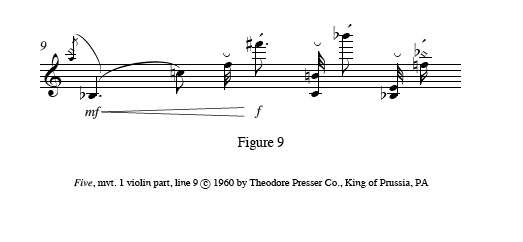
The sense of spaciousness created by this passage is especially dramatic, as the violin roams in an extended solo, untethered to the piano part. Shapey’s “downbeats” create an unsettling, jagged character. Shapey also uses the dotted rhythm as a conventional, emphatic closing gesture, as in line 4 (which is repeated at the end of the movement ) (Fig. 8).

Dotted rhythms do not play much of a role in the rest of Five. However, the last movement contains one other transformation of this rhythm that can be seen in Shapey’s other works: chords. Chordal playing on stringed instruments usually necessitates that the notes be somewhat arpeggiated, because the bow must traverse the curve of the bridge as it contacts the strings. This causes a grace-note-like effect that can also be interpreted as a kind of dotted rhythm, depending on how the “upbeat” notes are articulated or lengthened. Shapey maximized this effect by writing chords involving not only all four strings, but also large intervals, and left-hand positions requiring unusual extensions and knotty fingerings. Consequently, there is an added measure of time and effort involved in crossing from one side of a chord to the other. He also often included dissonant, clashing intervals within the chord, creating timbral tension. For example, the first violin chord of the fifth movement is Ab-A-Bb-E. This requires a moderate stretch from Ab to A, plus a movement of the first finger from the Ab on the G string over to the Bb on the A string, necessitating an arpeggiation. The minor second, A-Bb, and the tritone, Bb-E, inject jolts of dissonance, which lead into the sound of the bright, sustained open E string  (Fig. 10)
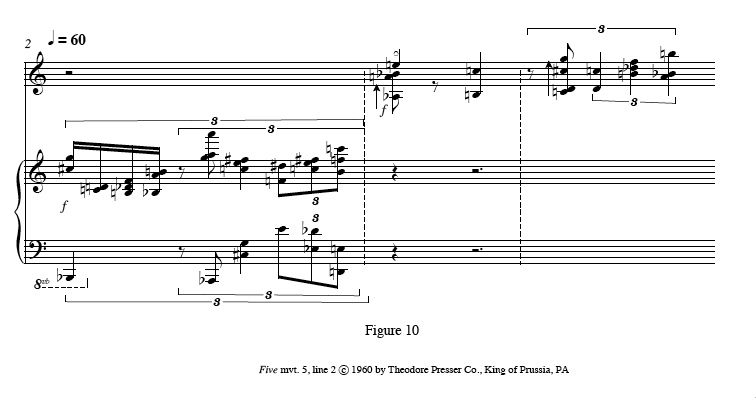
In the next “bar” (Shapey used dotted bar lines here), B-Db-F is an especially awkward chord, which I choose to play by shifting from a double-stop in second position (B-Db) to one in first position (Db-F). This splitting of the chord into two components creates an aural result similar to that produced by the broken chords around it, and is in keeping with the heavy, laborious character of the passage.

The various dotted rhythm gestures seen in Five are plentiful in Shapey’s Partita, written five years later. Like Five, this three-movement solo work features a great deal of chordal writing, involving complex, tangled fingerings and wide intervals. The intervals are often dissonant, so it is important to use sweeping arm movements to draw rich sound from the strings, so that the pitches resonate and can be heard clearly. The frequent splitting or arpeggiating of the piece’s numerous chords contributes to the craggy robustness of the music.

In addition to chords, Shapey makes much use in the Partita of quick upbeat triplets, and also employs his upbeat and downbeat symbols. As in Five, these symbols serve a meaningful purpose, for the rhythmic emphasis can be ambiguous unless elucidated by the player. There are no bar lines in the first two movements, so the rhythmic values and patterns are irregular and the main emphases come at unpredictable moments.

In the first movement, a theme and five variations, melodic and rhythmic units recur in modified forms, or are rearranged in different orders. In the opening sections, the ideas are grouped into fragments. The music progresses in compact, declamatory bursts.  Long, sonorous tones are often preceded by sixteenth notes, on which Shapey placed upbeat symbols. The upbeats are usually double-stopped or chordal, requiring  firm bow articulation (Fig. 11).
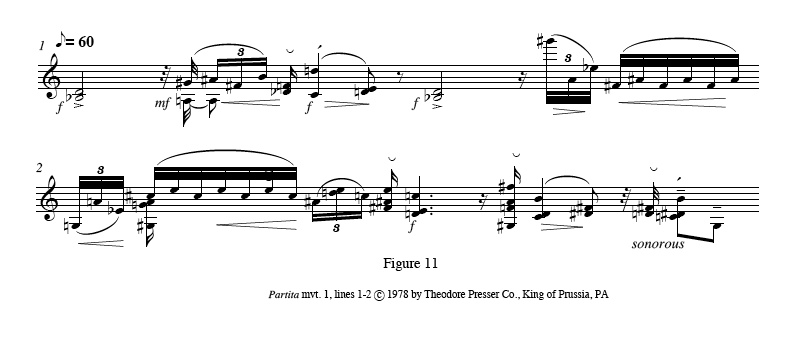
The beginning of the scherzando third variation presents a more continuous line, which jumps delicately across wide intervals. In this variation, the dotted rhythm is one of several small rhythmic cells that are strung together horizontally, including triplets, parts of triplets, and single eighth notes. As the various motives alternate, there is little sense of any beat or pulse, and the dotted rhythm becomes less distinct as a recognizable “object,” its components now forming part of a disjointed rhythmic line (Fig. 12). 
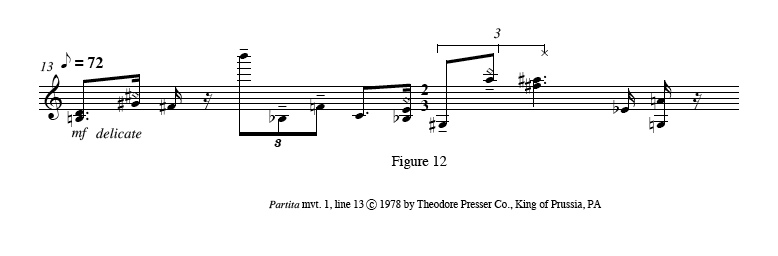
The fourth variation is labeled “march-like.” Its dotted rhythms move twice as fast as those in the preceding sections (FigEx. 13). Mostly double-stopped, these rhythms require clean attacks to project their crispness. The variation also includes weighty four-note chords, involving awkward left-hand fingerings. The effort entailed in breaking the chords clearly is again an important factor in conveying the expressiveness of the music.  
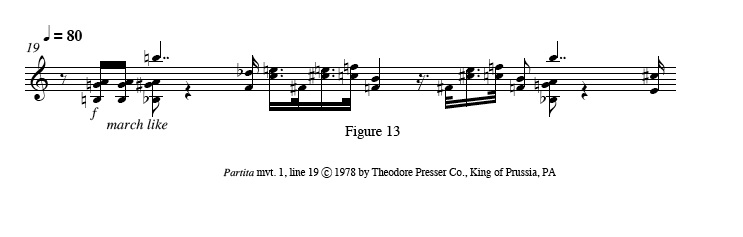
The third movement of the Partita consists of a Grosse Fuge-like series of dotted rhythms. In this case, the rhythms are actually double-dotted, a characteristic which imparts an especially jaunty springiness to the music. The dotted-rhythm “objects” are grouped into short phrases that usually open with a quarter note or eighth note sforzando upbeat. These sforzando attacks (marked with an upbeat symbol at their first few appearances) are basically an exaggeration and elongation of the upbeat idea. Their weighty gravitational pull counterbalances the airborne lightness and clipped quality of the thirty-second note in the double-dotted rhythms (Fig. 14).
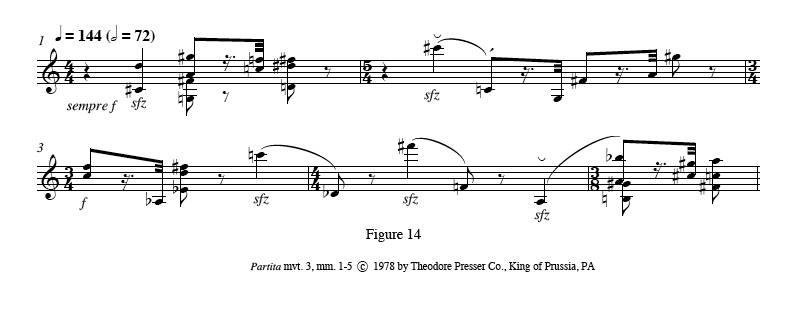
In the movement’s middle section, beginning in m. 51, Shapey turned the double-dotted rhythm into a witty and technically tricky figure. He transformed the upbeat thirty-second note into a left-hand pizzicato, which leads in most instances to a bowed double-stop.  The pizzicati are played on open strings, facilitating their execution and requiring clean and quick moves from pizzicato to arco (Fig. 15).
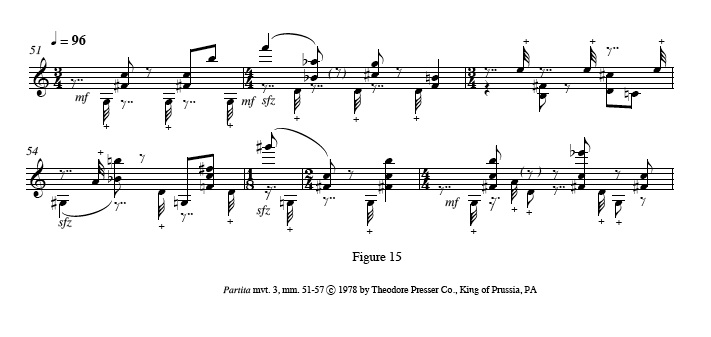
            Mann Soli is composed of a theme and five variations, the theme returning at the end of the piece. The dotted rhythm is a central element of the material. The maestoso theme is written across two staves, the lower staff with the primary rhythm and pitches, while four-stringed grace-note chords are placed on the upper staff. (Fig. 16). The lower staff’s “melody” is in double-stopped fourths or fifths, and moves at a steady pace. Grouped into a few short phrases, it features weighty, double-dotted rhythms in the first measure and mm. 3-4. This powerful, declamatory line serves as a rhythmic foundation for the grace-note chords attached to it. Massive and very intense, with their wide intervallic range, strikingly dissonant intervals, and bright topmost notes on the E string, these chords must be split into two double-stops, essentially forming two-note grace-note figures. They repeatedly deliver huge upbeat motions that land forcefully on the subsequent beats of the theme. When combined with the main line’s own dotted rhythms, they produce a series of three upbeat articulations, fired off in a row with jarring intensity.
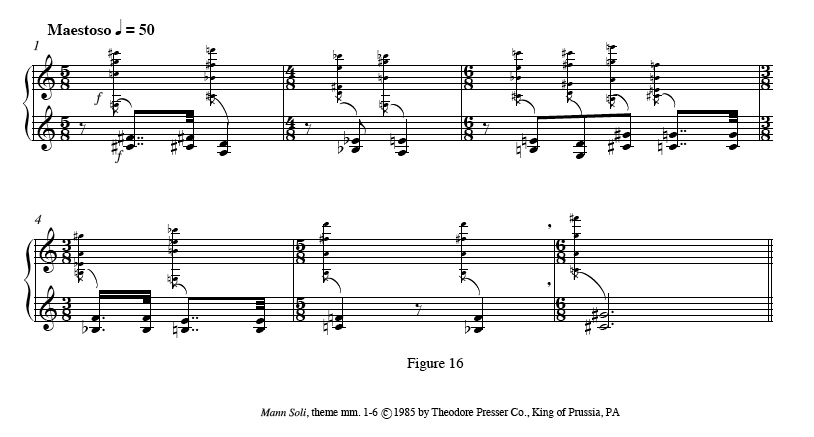
The first variation incorporates the dotted rhythm simply, with a single dotted figure opening each phrase. In the second variation, Shapey again employs the double-dotted rhythm, as he turns the theme into a primarily monophonic line that jumps around across an enormous pitch range (Fig. 17). The violin writing includes many vaulting left-hand leaps. Elaborate four-note chords punctuate many of the variation’s longer sustained notes. These chords directly recall the grace-note chords in the main theme, both in their intervallic make-up, and in the rhythmic effect of their arpeggiation. Shapey ties the second-highest pitch in each chord into the following held note, and writes, “break bottom to top & back to hold note,” along with a symbol that combines two arrows, one pointing upward, the other curving back downward. This kind of bi-directional arpeggiation is an established technique among string players, and is sometimes used in polyphonic works, such as the solo sonatas of Bach, in order to bring out specific inner lines. Shapey’s employment of the device serves that purpose, while replicating the swooping motion of the opening theme’s grace-note chords, which break upward in two double-stops, then veer back downward to arrive on the main notes.
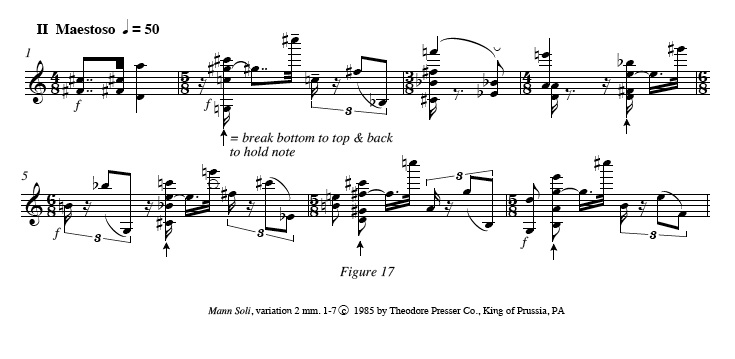
In variation 3, dotted rhythms appear as part of a legato melodic line that moves by large intervals between the violin’s middle and high registers (Fig. 18). Quiet and spare, the variation conveys a remarkable sense of vast expanses of space and time. While the melody is essentially slow-moving, the dotted rhythms gently nudge it forward, with quick motions toward the subsequent beats. The large leaps in the dotted rhythm figures suggest a tightrope walker, making exquisitely graceful leaps above an open expanse.
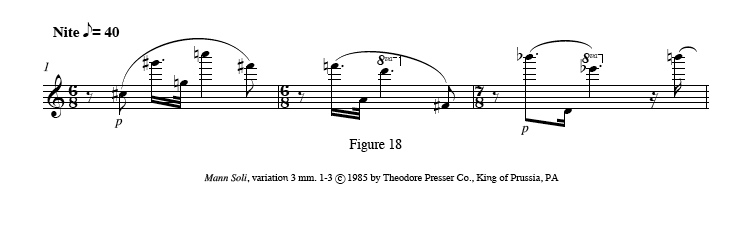
The fourth variation is based entirely on dotted rhythms, bunched in brief phrases that halt on double- or triple-stopped chords, played on strong beats. In the fifth variation, the dotted rhythm is subsumed into a contrapuntal, polyrhythmic texture in which two cantabile melodies, written on separate staves, are played simultaneously. The two lines are closely entwined, crossing each other registrally, and interlacing disparate rhythms. The dotted rhythm is combined with large leaps, forming graceful, Romantic gestures, and leading the long, meandering phrases toward points of expressive focus (Fig. 19).

Since it is technically impossible to play both melodies at once, one must foster this illusion by seamlessly alternating between the voices and employing unusual fingerings. Shapey provides little clue as to how to execute the passage. There are various possible solutions, depending on which tones one chooses to sustain or drop. In m. 1, I play the two lines simultaneously by momentarily dropping the D# on the A string to play the B with the first finger. The B is then double-stopped with the open D string, and with the G on the E string. In this way, the dotted-rhythm leap is traversed, while both lines are continuously sustained. In m. 2, I choose to drop the lower line at the leap. Leaving the B-E fifth that occurs on the last sixteenth note of beat 1, I shift to fourth position for the A, playing it alone before bringing in the B flat on the D string on the second triplet of that beat. This allows for a smooth technical transition, and also creates a moment of open space in which the A sings through.
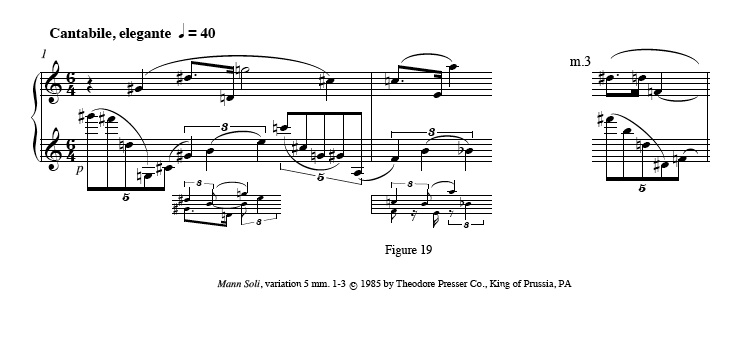
In this variation, the dotted rhythm is sometimes a passing element in the fluid texture of the music, rather than a focal point. In m. 3, it is placed against an eighth note quintuplet. The two lines are briefly entangled, then unspool, as the dotted rhythm occurs simultaneously with the quintuplet. At the point where the two rhythms intersect, the lines share a common pitch, D natural, which ties them together momentarily, and obfuscates the rhythmic distinction of the dotted figure (Fig. 19).

I play the upper-line D with the first finger, combining it as a unison with the lower-line D, played with the fourth finger on the D string. The fourth finger is then double-stopped with the F, played with the third finger on the G string. In order to sustain both lines, I shift to second position, moving the F to the first finger on the D string. The D# and F in the quintuplet are played on the G string.


Whereas Shapey’s music of the 1960s-80s is freely gestural and fragmented, his late works show a return to long lines and a strong metrical pulse, with simple rhythmic ideas interlocking in a dense web. Millenium Designs, for violin and piano, presents swathes of neatly meshed counterpoint, in which rhythm and texture are more important than melody. Formed of sections that recur in different movements, the piece is a large-scale patchwork of shifting characters. The dotted rhythm is very prevalent in this piece. It bears traits of both the weighty upbeat gestures of his middle-period music, and the Classical elegance of his early pieces.

The opening is a mighty refrain that returns both at the end of the movement and the end of the work. The instruments establish a slow eighth-note pulse as they alternately play heavy chords. The dotted rhythm is present by virtue of the violin’s splitting of the chords, which pushes the motion onward, while also evoking a sense of labor and struggle. In the violin’s repeated gesture of three eighth notes, Shapey increases the effect of the crescendo by making the last of the three a four-note chord, typically involving dissonant intervals and awkward fingerings. The piano’s chords are insistent, with upbeat gestures comprised of pairs of either grace notes or thirty-second notes (Fig. 20).
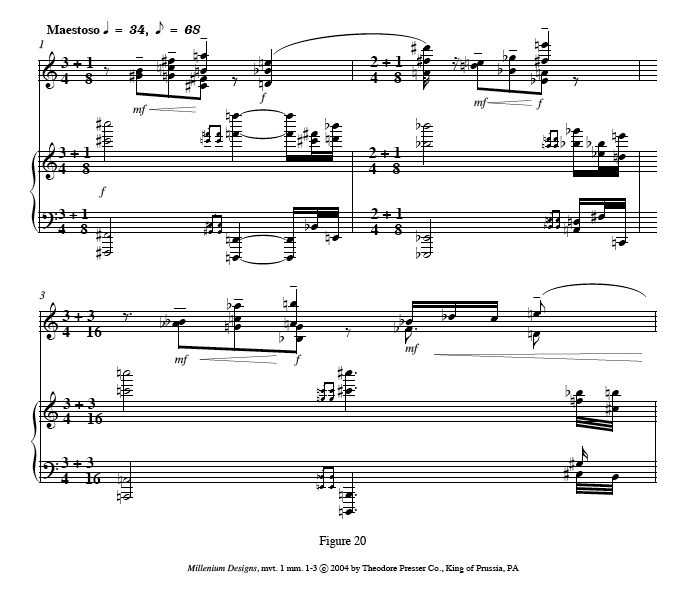
In much of the rest of the piece, the dotted rhythm is tightly locked within an eighth-note-based framework. The squareness of the rhythmic cells and neatness of the “objects” harks back to the neoclassical character of Etchings. In Millenium Designs, the dotted rhythm suggests certain emotional traits. In sections of moderate tempo, such as m. 10 in the first movement (Fig. 21), it creates a gentle tension, as the listener waits momentarily for the arrival of the next note. Shapey sometimes enhances this effect by double-dotting.
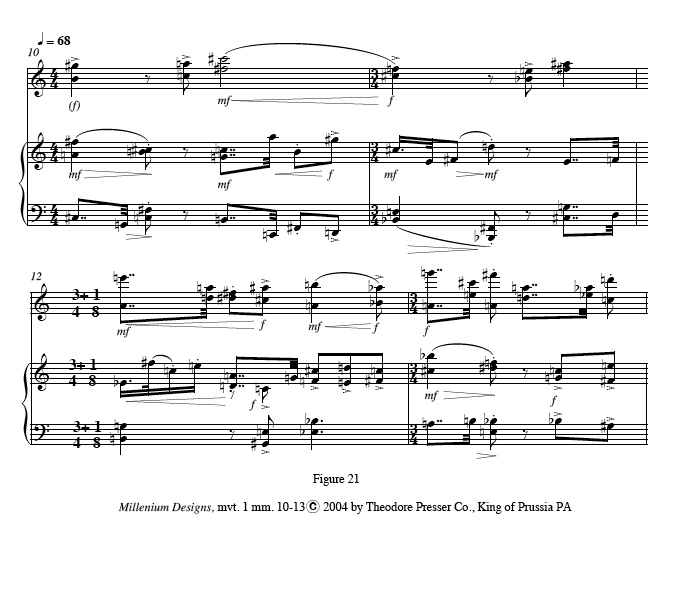
In faster sections (Fig. 22), the dotted rhythm has a jaunty character, conveying a more vertical stress, even as the music proceeds in a linear fashion. This jauntiness contrasts with the firmness and swagger of the section beginning at m. 55, where the violin plays groups of notes of equal value (Fig. 23).

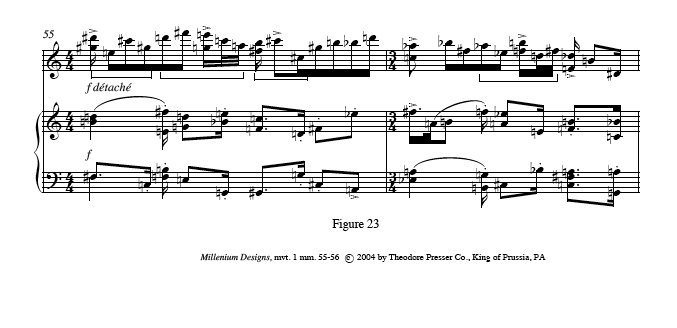
Shapey’s manner of interlocking the dotted rhythm with other rhythmic units can be likened to Beethoven’s procedure in passages of the Grosse Fuge. At m. 111, the dotted rhythm is played by the cello, landing on the beginning of each beat of the 4/4 bar (Fig. 24). It is combined with the second violin’s repeated anapestic figure of two sixteenth notes leading to an eighth note, and with the first violin’s cross accents on the second half of beats 1 and 3. This layering of rhythms creates a texture in which one hears several discrete lines simultaneously, with emphases occurring one after the other in quick succession.
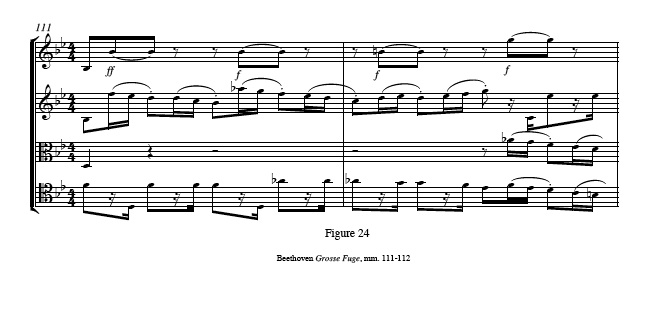
Beethoven was clearly the main exemplar of Shapey’s musical ideals. Even more than Haydn, Mozart, or Bach, Beethoven invested the individual motive with charged expressive significance, giving his music the etched impact of a “graven image.” The powerful character of Shapey’s music, whether rugged and bold, or ethereal and lyrical, is especially close in spirit to that of Beethoven. Furthermore, Shapey’s idea of virtuosity seems particularly akin to Beethoven’s. Although both composers sometimes brought agile brilliance to the fore, they often embraced a sense of physical exertion, making it an expression of strength in their music. Beethoven’s music sometimes appears blatantly to disregard the norms of idiomatic instrumental writing, aiming instead for a purely musical objective. His works can be very unidiomatic for stringed instruments, using patterns often more suited to the piano. With his knowledge of the violin, Shapey worked to push the performer to the extremes of established technique, designing technical challenges to convey the toughness, strenuousness, and spaciously dramatic qualities of his music. In this way, his pieces achieve the near-tangibility of their musical ideas through the physicality of their execution, and they expand the range of expression that virtuosity can supply.


1 Music by Ralph Shapey, Centaur CRC 2900. Miranda Cuckson, violin, Blair McMillen, piano.

[i] Robert Mann, interview by author, New York, 4 September 2007.

[ii] Anthony Tommasini, “Music; Rugged Music Once Packaged in Plain Brown,” The New York Times, 10 November 2002.

[iii] Robert Carl, CD liner notes, Ralph Shapey: Radical Traditionalism, New World Records 80681-2.

[iv] Cole Gagne and Tracy Caras, Soundpieces: interviews with American composers (Metuchen, New Jersey: Scarecrow Press, 1982),
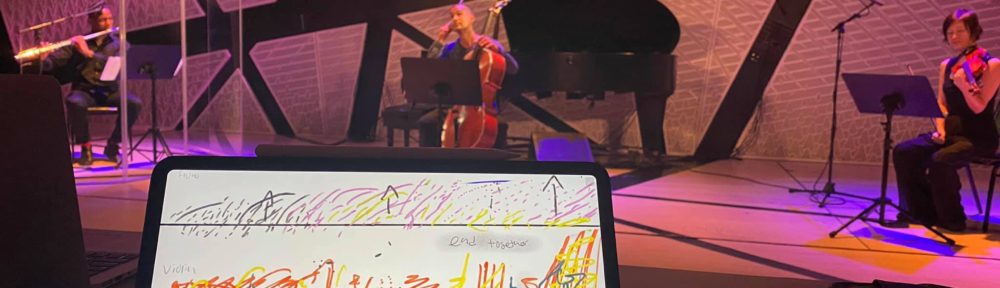
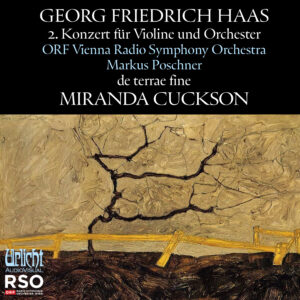
My meeting with Henri Dutilleux

Henri Dutilleux was one of the great artists of the last century and a wonderful man, and I treasure my memories of meeting him and playing for him in Paris one summer. Following the very saddening news of his death, Sequenza21 asked me to write about my visit with him. My little essay is now posted here on the Sequenza 21 site, also here on Tumblr (with larger photos). (A note: M. Dutilleux wrote the date wrong in his dedication on my score. It was 2001.)

new year

Happy new year! A reminiscence: New Year’s Eve was the birthday of Nathan Milstein, whom I played for when I was 13. Around that time, he used to give a week of masterclasses in Zurich each year. Someone gave him a tape of me playing the Paganini concerto at a Juilliard concert and he invited me to come. Corey Cerovsek and I were there along with about a dozen college students. Over the week, I played movements of the Tchaikovsky concerto and Beethoven Op. 30 No. 3 sonata, Wieniawski D major Polonaise and Zigeunerweisen. (I brought Bach but didn’t get to play it).  On the 2nd to last day, my parents and I went hiking and the next day, I had an awful fever…at the end of the last session, he hugged me and said to my mother, ” time to take her home now!”

I remember him joyfully playing Bach sitting at a table…at pauses or while speaking, he kept grabbing lengths of a beautiful dark silk patterned scarf and stuffing it between his chin and the violin, with the rest of the scarf cascading down his front.  In the excitement of playing, he kept knocking the scroll of his beautiful Strad against the table, at which we would all jump and glance at each other. He stuck to a limited repertoire all his life, but he played those pieces so beautifully, his unique sound a combination of warmth and tenderness on the one hand, and directness, nobility and backbone on the other. He found endless things to play around with, fingerings and bowing to change, notes and lines to bring out.

The year having turned to 2012, I’m looking forward to some great programs of music in the next few months. My group counter)induction is playing several times in NY: the first is at Scandinavia House on January 23, an intense program of works by Finnish composers Magnus Lindberg, Jukka Tiensuu, Kaija Saariaho, and Esa-Pekka Salonen. Lindberg, currently composer-in-residence with the NY Philharmonic, will host the evening. On March 4, we play at the Italian Academy, presenting pieces by Luigi Nono, Schoenberg , Helmut Lachenmann and Kyle Bartlett.

I’m honored and excited to have been asked to celebrate iconic violinist Fritz Kreisler at the Library of Congress on February 3. Subsequent to my playing of Elliott Carter’s Duo at the Library on a Sequitur concert, the LOC’s McKim Fund has commissioned my friend Harold Meltzer to write me and Blair McMillen a violin/piano piece for the occasion. Also on the program, Cygnus Ensemble will play Harold’s Pulitzer-nominated piece Brion, I and players from Cygnus will perform Kreisler’s String Quartet, and Cal Wiersma and I will play some of Kreisler’s salon pieces. I am thrilled that the Library is lending me Kreisler’s Guarneri violin, which he gave to their instrument collection, for this concert!

I am playing several more times in DC this season- a recital titled “Time and Tide”, with music by JS Bach, Ysaye and Hersch and presented by George Washington and Catholic Universities; and a couple of lovely programs at the Phillips Collection: a recital of Janacek, Strauss and Finney, and a chamber music program.

I am also eagerly anticipating a lot of new music! Some premieres this spring: new works by Alex Sigman, Cenk Ergun and Mika Pelo, written for me. Excited to play very talented composer Sean Shepherd’s music on April 23, with Aaron Wunsch, the Claremont Trio and NYPhil oboist Liang Wang. My father Robert Cuckson’s String Quartet is on Feb. 15, which we’ll then take immediately into the studio to record. A tough Xenakis duo at Princeton, another go at the great Ligeti horn trio in April.

So it continues… I’d also just like to say, for those who might have noticed, that I was sorry to cancel the Nunc concert I had planned for this month. I was looking forward to duos with some terrific friends/colleagues and some very cool pieces. But I decided to free up my schedule and take a bit of time off after a busy autumn, and wanted a few weeks to take care of some issues with my violin itself and with my health.  I will probably reschedule that program, or something similar, for next season. Nunc is in process of incorporation and I am planning a few things for next season. Not a lot, no rush, just a start for my new organization. Nunc is a long-term aspiration and interest of mine, a sandbox for me to play in and a way, I feel, to be a thoughtful, contributing artist, not just playing well but dealing with the repertoire and its various main streams and intriguing tributaries, thinking and making sense of it and discovering the specifics that give them their communicative power.